Larry Fink’s 2026 Annual Chairman’s Letter to Investors
At a glance
01.
Markets are driving more of economic growth
In a period of significant uncertainty, a growing share of economic value is being created in the capital markets. That creates a powerful opportunity—but only for those investing for the long term.
02.
Growth is reaching too few people
Countries are investing more at home, wealth has flowed mainly to asset owners, and AI could accelerate that trend—creating more value, but concentrating it among those already invested.
03.
The opportunity is to broaden ownership
Expanding long-term investing—through retirement systems, earlier access, and modernized markets—can help more people share in economic growth and build long-term financial security.
Growing with your country: Thoughts from a long-term optimist
Every year, I write this letter as a distillation of a year’s worth of conversations with clients and employees, world leaders, CEOs—and people investing for their retirement. Lately, no matter who is speaking, they’re saying the same thing: We’re not sure how to navigate this moment.
It’s understandable. We are living through a period where things that would've defined a decade have become routine: wars with global repercussions, trillion-dollar companies, a fundamental reordering of international trade, and the advent of the most significant technology since, at least, the computer.
Too often, this gets filtered through a short-term lens. Daily market moves are treated as signals of lasting change, and complex economic or technological transitions are compressed into headlines. We live in a world where information moves instantly, and reactions follow just as fast. At times, it can feel dopamine-driven—where constant input rewards short-term impulses. But speed can distort perspective, crowding out long-term thinking.
To be fair, in financial markets all this short-term activity serves a purpose. It’s how new information is absorbed, risks are priced, and capital is allocated.
But over time, staying invested has mattered far more than getting the timing right. Over the past two decades, every dollar invested in the S&P 500 grew more than eightfold. Miss just the ten best days, and you would have earned less than half.1 And some of the market’s strongest days came amid the most unsettling headlines.
The danger is that we focus so much on the noise that we forget what actually matters. The forces behind today’s headlines have been building for a long time. The old model of global capitalism is fracturing. Countries are spending enormous sums to become self-reliant—in energy, in defense, in technology.
Meanwhile, the vast majority of wealth has flowed to people who owned assets, not to people who earned most of their money by working. Since 1989, a dollar in the U.S. stock market has grown more than 15 times the value of a dollar tied to median wages.2 Now AI threatens to repeat that pattern at an even larger scale—concentrating wealth among the companies and investors positioned to capture it.
This is where much of today’s economic anxiety comes from: a deeper feeling that capitalism is working—just not for enough people. And a focus on short-term investing is not a fix for that. Rather, it is long-term investing that allows countries to build domestic industries, that lets people build enduring wealth and shows how their country’s growth can benefit them too.
At its best, long-term investing performs a kind of civic miracle. When people invest their savings—over decades, not days—the capital markets put that money to work, financing companies, infrastructure, and jobs. And when that cycle happens in your own country, your future and your nation’s future become linked. You help finance its growth. It helps finance yours.
My belief in this civic miracle is obviously shaped by my job. But I’m not speaking only as the CEO of BlackRock—that belief reflects decades of experience seeing how investing can help more people share in economic growth.
It is also grounded in something more personal. My father was born in 1925. My mother in 1930. They didn’t come from a lot of money. My dad owned a shoe store. My mom taught English. But they saved what they could and invested it.
This was the 1950s and ‘60s, right when the Interstate Highway System was being built, the mid-century industrial boom was taking off, and the auto sector was reshaping American life. And in their own small way, they helped finance all of that. They were part of the capital that built modern America. And over time, the gains flowed back to them. By the time they retired, they had enough savings to live comfortably well past 100. Because their wealth compounded alongside the American economy.
And that dynamic extends far beyond the United States. Across countries and generations, the pattern has been remarkably similar. Families who invested broadly and consistently—through depression and war, through inflation, financial crises, and even a global pandemic—had the opportunity for their wealth to grow alongside their economies. That history is why I remain a long-term optimist. Not because the path is smooth, but because markets have tended to reward those who stay invested through uncertainty.
That is what this moment is about. Expanding that opportunity. Ensuring more people can own a stake in their country’s growth. Because today, too many are left out.
Many people don’t have the money to invest in the first place—households living paycheck-to-paycheck. You can’t invest if you’re not sure you can afford next month’s rent, next week’s groceries, or an unexpected bill. So the starting point has to be helping people build basic financial security.
And that’s starting to happen. Emergency savings accounts where employers can match contributions and workers can withdraw penalty-free are gaining traction. And a growing number of countries are experimenting with investment accounts seeded at birth, giving kids a stake in their country’s growth from the time they leave the hospital.
Even where savings exist, participation remains limited. The U.S. likely has the highest rate of market participation in the world. Still, roughly 40% of the population has no exposure to the capital markets.3 Around the world, participation is far lower.4 Billions watch their economies grow from the outside, as renters rather than owners—putting their savings in bank accounts that earn little, rather than investing to share in the growth around them.
Markets work when investors trust they can buy and sell at a fair price. That trust helps businesses raise the capital they need to grow, and it allows families to spread their investments across many assets at low cost instead of relying on just one. Expanding access to that system—through better technology and financial education—could help more people share in economic growth. Over time, the same technological advances could also help bring greater transparency and potentially broader access to parts of the private markets—areas like infrastructure and private credit that have traditionally been out of reach for most individual investors.
Half the world’s population carries a digital wallet on their phone.5 Imagine if that same digital wallet could also let you invest in a broad mix of companies for the long term—as easily as sending a payment. Tokenization could help accelerate that future by updating the plumbing of the financial system—making investments easier to issue, easier to trade, and easier to access.
I start this letter with the forces that make this conversation particularly urgent right now: the reshuffling of global trade, the inequality that’s risen over the past generation, and how AI threatens to widen the gap without broader market participation.
Then I’ll offer four examples—among many—of how countries are already expanding market participation and helping more people grow with their economies.
The final section turns to BlackRock’s work with clients, which advances many of these same goals.
One last thing: Writing this letter is part of my duty to our shareholders and clients. But it is also a letter. And letters are meant to begin conversations. I hope this one does. I’ll be seeking out a range of perspectives, and I intend to spotlight some that meaningfully advance the discussion.
This is where much of today’s economic anxiety comes from: a deeper feeling that capitalism is working—just not for enough people.
Why growing with your country has never mattered more
First, the world is reorganizing around self-reliance. And that requires more long-term investment.
Everywhere I travel, I hear some version of the same thing. Europe is building up its own defense industry. Emerging markets are developing domestic energy. The United States is trying to rebuild its manufacturing sector. The details differ, but the trend is obvious: Countries are investing to become less dependent on one another.
They’re doing it for a reason. For many governments, accepting higher costs in pursuit of self-reliance is seen as an investment in resilience and long-term competitiveness—strengthening domestic industrial capacity, anchoring jobs and investment at home, and securing greater control over critical sectors.
But that transition is expensive. Sourcing critical minerals like rare earths outside China and building chip fabs outside Taiwan cost significantly more. Every step toward self-reliance means, at least temporarily, giving up the global economies of scale that kept costs down for decades. Put simply: In the short run, self-reliance is costly.
So where does the money come from? Historically, most of the financing for big economic shifts came from banks, corporations, and governments—not the capital markets. And that makes sense. That’s where people put their money. They parked savings in bank accounts, drove corporate growth by buying goods and services, and paid taxes that funded public investment.
But those channels aren’t enough anymore. Banks alone can’t finance what a growing economy needs. Governments are carrying record debt. Even the wealthiest economies in the Gulf—sitting on enormous sovereign wealth—aren’t funding their ambitions with public money alone. And when the Magnificent 7 companies build out data centers or power infrastructure, even they turn to the capital markets.6
More and more, the money for self-reliance is coming from the markets. And there’s a natural logic to making sure more of it comes from domestic investors.
For decades, capital chased returns around the world—often without enough benefit to the people back home. Money should still move freely toward opportunity. That’s what makes markets work. But it doesn’t mean countries can’t also do more to help channel capital into their own growth.
Energy abundance and affordability
For several years, I’ve argued for energy pragmatism. Meeting rising demand will require expanding supply across oil and gas, renewables, storage, nuclear, and grids. No single source can do it alone.
But in the United States, one point is becoming hard to ignore: If energy is to remain affordable for families, more power needs to come online—and quickly.
Electricity demand is rising again after years of relative stability.7 Homes are more electrified. Industry is expanding. Data centers require large amounts of reliable power. At the same time, adding new generation and transmission capacity takes years. When supply grows slowly and demand rises faster, prices move up.
Natural gas remains essential for reliability, and the U.S. has abundant supply.8 But gas alone is unlikely to meet projected growth in electricity demand in every region. A broader expansion of capacity will be necessary. Nuclear power will also be critical over the longer term—but new capacity takes time to develop, reinforcing the need to scale additional sources now.
Solar is likely to play a significant role in that expansion. It is one of the fastest sources of new power to deploy, and over the past decade its costs have declined substantially.9 Solar does not replace other sources—it complements them. Paired with battery storage and upgraded grids, it can help increase total supply and ease price pressure over time.
Supply chains matter. Today, much of the world’s solar and battery manufacturing capacity is concentrated in China.10 For reasons of resilience and security, the United States and its partners are investing in diversifying production and expanding domestic manufacturing. Scaling solar in America should go hand in hand with building a stronger and more diversified supply base. That includes battery manufacturing and the critical minerals and components that underpin it, which are increasingly central to energy security and industrial competitiveness.
The principle is simple. Affordable energy depends on abundant energy. When power is scarce, households feel it first—in monthly utility bills and in the broader cost of living. When supply expands reliably, economies grow and families benefit.
The goal is not to favor one technology over another. It is to ensure that the United States can generate enough dependable, cost-effective electricity to support both household budgets and long-term competitiveness. That will require speed, scale, and sustained investment across multiple energy sources—including a meaningful expansion of solar.
Second, broader participation in investing can help address the wealth inequality the last era of global capitalism left behind.
Since the fall of the Berlin Wall, more wealth has been created than in all prior human history.11 In the developing world, more than a billion people escaped extreme poverty and entered the middle class.12 Companies in the developed world gained access to vast new markets. Consumers got cheaper goods. But in rich countries, the benefits accrued to too few people.
There’s a vast body of economic literature on how we got here. But the simplest, and maybe least discussed, explanation is that most of the wealth flowed to the capital markets—and too few people were invested in them.
For many families, wealth-building instead centered on a single asset. Homeownership was the primary way middle-class families built wealth. For many, it still is.
But housing is not a guaranteed high-return investment. Once you account for property taxes, insurance, maintenance, and transaction costs—all of which have risen meaningfully in many places—long-term returns can be more modest and more uneven than headline price increases suggest.
This isn’t uniquely American—across many advanced economies, rising housing costs and tighter lending conditions have made homeownership harder to access, especially for younger people.
A home provides stability, community, and a means of forced savings—benefits that go well beyond financial return. But if we want broader participation in economic growth, we cannot rely on a single asset, purchased later and later in life, to carry that burden alone.13
It’s hard not to empathize with people dealing with this. If you no longer believe your job is a path to success, believe that you can’t afford a home, or believe that even if you can, it won’t build a lot of wealth, then the economy doesn’t feel like it’s working for you. No country can prosper if that’s how its citizens feel.
Plenty of ideas have been put forward to address this. But if prosperity is increasingly being created in the capital markets, part of the answer is to make sure more people are invested in them.
That doesn’t diminish the real challenges around housing affordability or the fact that earnings for many households have not kept pace with asset values. It simply means a critical part of the solution is bringing more people into the capital markets—so they can share in the growth already taking place, not just watch it from the sidelines.
If prosperity is increasingly being created in the capital markets, part of the answer is to make sure more people are invested in them.
Third, there's a real risk artificial intelligence could widen wealth inequality if ownership does not broaden alongside it.
When we talk about the economic disruption of AI, most of the conversation is about jobs. That’s an enormously important question, and one that goes beyond economics. Work provides income, purpose, and dignity.
But history suggests that transformative technologies create enormous value—and much of that value accrues to the companies that build and deploy them, and to the investors who own them.
The economy is rewarding scale like never before. In industry after industry, we’re seeing more divergent, “K-shaped” outcomes, where leading firms pull further ahead while others struggle to keep pace. The contrast can be striking: Walmart reached its highest-ever valuation, two weeks after Saks went bankrupt.14
AI may accelerate this trend further. The companies with the data, infrastructure, and capital to deploy AI at scale are positioned to benefit disproportionately. That is not unusual, and none of this is inherently problematic. Market leadership has always shifted with technological change. The broader question is who participates in the gains. When market capitalization rises but ownership remains narrow, prosperity can feel increasingly distant to those on the outside.
AI is here to stay. It is central to strategic competition between the United States and China. The U.S. clearly sees that AI leadership is not optional, and that it will require sustained investment—in research, infrastructure, talent, and the capital markets capable of financing innovation at scale.
AI is also reshaping investing itself. Long before generative AI captured the public imagination, advances in data science and computing were transforming how investors analyze markets, manage risk, and allocate capital. One result has been the growth of systematic investing—an approach that uses large datasets, research-driven models, and disciplined processes to evaluate thousands of securities consistently and at scale, rather than relying solely on individual judgment.
BlackRock has spent four decades building these capabilities: expanding our data, refining our models, and applying technology to identify patterns and manage risk to help clients achieve better outcomes over time. As these tools become more powerful, we believe the combination of systematic insight and human oversight will help define the next era of investing.
One thing is clear: AI will create significant economic value. Ensuring that participation in that growth expands alongside it is both the challenge and the opportunity.
One quick thought on AI and the labor force
Historically, automation has increased productivity and, over time, expanded the range of available work—even as it displaced specific roles. AI may do the same. But new roles take time to emerge, and workers don’t always move seamlessly from old ones to new ones.
There is no consensus on what AI will mean for the labor market—particularly for entry-level white-collar roles. The truth is, no one knows with certainty.
In the near term, there are roles we know are in clear demand, and pay well: skilled trades, especially the ones building the physical infrastructure of AI, like data centers, power systems, and electrical grids. In the U.S., employment for electricians is growing 3x faster than the national average.15
Many of these jobs pay well over the median wage, in many cases six figures. And that’s true across many Western economies.16
As NVIDIA President and CEO Jensen Huang told me: “Everybody should be able to make a great living. You don’t need a PhD in computer science to do so.”
The question is how to get more people into these jobs. The skills gap is real and requires sustained investment in training and apprenticeships. That’s why The BlackRock Foundation launched Future Builders, a $100 million philanthropic initiative to expand economic opportunity and power the next generation of America’s skilled trades workers, reaching 50,000 workers over the next five years.
But the issue runs deeper than training. For decades, many societies have equated success with a university degree and a white-collar path. As technology reshapes parts of that landscape, we need a broader conversation about opportunity, dignity, and the value of different kinds of work. What are we going to do about that?
It’s a conversation worth having.
At 5%, U.S. employment in skilled trades is projected to grow faster than the 3% national average (Projected job growth 2024-2034)
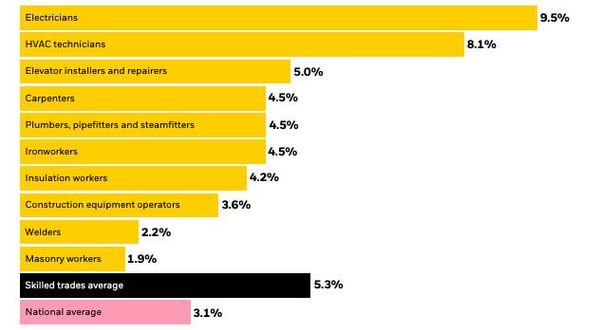
Source: BLS Occupational Outlook Handbook; BlackRock, 2026. Data last modified by the BLS as of August 2025. The national average includes all wage and salary workers, self-employed workers, and workers in agriculture and private households. Military occupations are excluded.
What growing with your country looks like—in practice
The United States
People often want to invest in their own country’s financial markets, but don’t have the means. A BlackRock survey shows that a third of Americans don’t have $500 for an emergency like a car repair.17 In fact, many are forced to pull money out of the markets just to make ends meet. Last year, a record number of workers withdrew money from their 401(k) plans so they could cover financial emergencies.18
The challenge is saving enough money to invest in the first place. That starts with emergency savings accounts. These are tax-advantaged rainy-day funds. BlackRock’s research has found that workers with emergency savings were over 70% more likely to contribute to their retirement plan.19 There’s now policy in the U.S. to encourage this. Workers can now save up to $2,500 (inflation adjusted) in emergency accounts linked to retirement plans, with employer matching and penalty-free withdrawals.20
Another way to get more people investing is through early wealth-building accounts. These are investment accounts given to children at birth. Countries like Canada, the U.K., and Singapore have experimented with them, often seeding them with government funding. And there’s a lot of evidence that it’s a good return on investment: On average, early wealth-building accounts make it more likely for someone to earn an advanced degree, start a business, and own a home.21
Now the United States is adopting a form of this policy with Trump Accounts. There is some nuance in how these accounts are funded. In some cases, it’s a pilot program funded by the government, which would need to be renewed. Funding can also come through personal contributions, or through certain employer match programs, such as the one we have at BlackRock for our employees. In other cases, the money comes from private funders.
We’ll see how these accounts evolve, but if they are structured thoughtfully, and paired with existing investment vehicles for education and retirement (like 529 and 401(k) plans), this could be a very significant step toward more young Americans growing with their country.
Still, there’s a potentially much larger wealth-creation lever worth talking about—though it’s certainly not easy to discuss: Social Security.
Social Security is one of the most effective poverty-prevention programs in history. According to the U.S. Census Bureau, it keeps nearly 29 million Americans from sliding into poverty each year.22 That’s an extraordinary achievement.
The issue is: Social Security provides stability, but it doesn’t allow most Americans to build wealth in a way that grows with their country.
Today, the system operates largely on a pay-as-you-go basis. Payroll taxes are used to pay current retirees, and the Social Security trust fund is invested primarily in U.S. Treasury bonds. In effect, workers lend money to the government and receive defined benefits in return. The structure, designed as a social insurance program, emphasizes stability and predictability. What it doesn’t do is let people grow their benefits along with the broader economy. The question is whether the Social Security system could allow both. Could a portion of the system be invested more like other long-term pension plans—carefully, broadly, and over decades—while ensuring the program remains a strong safety net?
This would not mean privatizing Social Security or putting it all into the stock market. It would mean introducing a measure of diversification, similar in principle to the federal Thrift Savings Plan, which manages retirement savings for millions of federal employees. The goal would be to strengthen the system over time while preserving its core guarantees.
Several proposals have been put forward to do something like this. Senator Bill Cassidy (R-LA) and Senator Tim Kaine (D-VA), for example, have proposed creating a new investment fund—parallel to the existing trust fund, not replacing it—that would be invested in a diversified mix of stocks and bonds to generate higher returns over time. The fund would require an initial investment of roughly $1.5 trillion and would be given 75 years to grow. During that period, the Treasury would continue covering benefits. Once the fund matures, it would pay the Treasury back and supplement payroll taxes going forward, helping close the gap between what the system takes in and what it pays out. No one currently on Social Security, or nearing retirement, would see any change to their benefits.
Market-based approaches aren’t just a thought experiment. In some states, it’s already happening. About six million state and local employees, many of them police officers, firefighters, and teachers, don’t contribute to Social Security. Instead, they rely on public pension systems that invest in diversified portfolios.23 If long-term investing is already helping millions of public servants build retirement security, it raises a reasonable question: Why shouldn’t more Americans have access to that same kind of long-term growth?
Other countries have taken similar approaches at a national level. Australia’s superannuation system, for example, invests retirement contributions in the markets and has grown into one of the world’s largest pools of retirement savings. A similar, carefully structured approach could be considered to strengthen Social Security.
I understand why any talk of changing Social Security makes people uneasy. Social Security is a core promise, and people rightly believe it should be honored. But under the current system, doing nothing could very well break that promise. Current projections show the trust fund won't be able to pay full benefits by 2033.24 Many young Americans doubt they'll ever fully see theirs. Addressing that gap will likely require multiple solutions. But thoughtful, long-term investing could be one of them.
I’ve written about Social Security before. Two years ago, I titled this letter “Time to Rethink Retirement.” It produced some criticism for even suggesting Social Security needed a fix. These comments probably will again now. But in my 50 years in finance, if there’s one thing I’ve learned, it’s that the problems we don't talk about are the ones that should worry us most. And that’s exactly why we need the conversation now—because the cost of waiting is only getting higher.
Social Security is a core promise, and people rightly believe it should be honored. But under the current system, doing nothing could very well break that promise.
India
India is entering a new chapter of economic growth. Stock markets have rallied. As one of India’s leading industrialists, Mukesh Ambani, put it to me in February: “This is our baby boomer generation—the Indian generation that believes they’ll make a better tomorrow than today.” And what’s remarkable is that India has laid the financial groundwork so people can own a stake in that future.
Today, about one billion Indians effectively carry a bank branch in their pocket.25 Through a digital wallet on their smartphones, they can pay, save, and transact digitally in rupees. While its main use today is payments, those same smartphones can become pathways into the capital markets. BlackRock’s joint venture with Mukesh Ambani’s Reliance Group—JioBlackRock—is focused on exactly this: helping more Indians become investors. In less than a year, the venture has brought in more than a million investors across the country.
This is not just a story about a country catching up to the existing financial system. It’s a story about building modern financial infrastructure from the ground up.
It also offers a lesson for the next evolution in market infrastructure: tokenization—recording ownership on digital ledgers to reduce friction, lower costs, and speed settlement. India’s system is not built on blockchain-based infrastructure—in fact, it has largely taken a different path. But that’s precisely the point. Its success shows that new financial rails don’t depend on any single technology. They succeed when policy, technology, and adoption move together.
The economies that built modern finance—the United States, the U.K., the EU—are now working to modernize long-established systems so traditional and digital markets can operate side by side. When you’ve built the world’s deepest capital markets, change can come more gradually. But the objective should be the same: making it easier for people to invest in the growth of their country.
A smartphone wallet you can invest from is already remarkable. But the world of investable options grows much larger as financial assets themselves become digitally native. The bond you own is still a bond—but it can move more efficiently across modern infrastructure.
Over time, that could allow a single, regulated digital wallet to hold not just payment balances, but a broad range of financial assets. In a single wallet, someone could hold exchange-traded funds (ETFs), digital euros, tokenized bonds, and fractional interests in assets that were once out of reach—from infrastructure to private credit funds. By lowering minimum investment amounts and making it easier to divide assets into smaller pieces, tokenization can open the door to more investors. It could also make it simpler for investors to receive information and cast shareholder votes. The goal isn’t novelty. It’s giving savers a simpler, more seamless way to participate in markets and build wealth.
As Rob Goldstein and I wrote late last year, we believe that tokenization today may be roughly where the internet was in 1996. It won’t replace the existing financial system overnight. Instead, picture a bridge being built from both sides of a river, converging in the middle. On one side stand traditional institutions. On the other are digital-first innovators: stablecoin issuers, fintechs, public blockchains. The task for policymakers is to help build that bridge as quickly and safely as possible.
Consistency will be important. Rather than writing an entirely new rulebook for digital markets, we should update the one we have so traditional and tokenized markets can work together. Tokenization also needs guardrails like clear buyer protections to ensure tokenized products are safe and transparent, strong counterparty-risk standards to prevent shocks from spreading, and digital-identity verification to manage the risks associated with illicit finance. This way, people can trade and invest with the same confidence they have when swiping a card or wiring money.
This is not just a story about a country catching up to the existing financial system. It’s a story about building modern financial infrastructure from the ground up.
Japan
For generations, Japanese households kept their savings in cash and low-yield deposits. That left ordinary people with slowly growing nest eggs for retirement—a real problem in a country with the world’s oldest population.26 It also left Japanese markets starved of the capital they needed to grow, which is part of Japan’s larger story of economic stagnation that began in the late 1980s.
But in 2022, Japan decided to double or even triple contribution limits for Nippon Individual Savings Accounts (NISA), which is Japan's version of a tax-advantaged investment plan.27 The accounts had existed for almost a decade, but the investment limits were low enough that most people barely bothered. Raising them made equities meaningfully more attractive, and it kicked off a positive cycle: More investors brought more capital to markets, rising markets made investing more attractive, and companies started to invest more in their futures.
Since the announcement, the Nikkei has gone from around 28,000 to over 50,000, benefiting many NISA account holders.28 Nearly ten million new investors have entered Japanese markets—roughly 8% of the entire population—in three years.29 And the NISA program is poised to grow exponentially as Children’s NISA kicks off in 2027, ensuring that generations of Japanese to come will grow up as investors.30
More investors brought more capital to markets, rising markets made investing more attractive, and companies started to invest more in their futures.
Germany
For many people, retirement is their first—and often only—meaningful connection to the capital markets. It is how workers become long-term owners of businesses, infrastructure, and innovation.
Germany is now debating how that connection should evolve. Like much of Europe, it faces a demographic shift: The population is aging, and the ratio of workers to retirees is declining.31 Across the European Union, there are now fewer than three working-age people for every person over 65, and public spending on pensions, healthcare, and long-term care together amounts to roughly one-fifth of EU GDP.32
Germany’s retirement system rests primarily on its statutory public pension, financed on a pay-as-you-go basis. Occupational and private pensions also play a role, but funded retirement assets remain relatively modest compared with the size of the economy. As a result, total pension assets in Germany are low relative to GDP compared with several other advanced European countries.33
In late 2025, the German government put forward proposals to expand tax-advantaged, state-supported private retirement savings.34 In parallel, a commission has been tasked with examining the long-term sustainability of the overall pension system—statutory, occupational, and private pillars alike.35 The aim is not to replace the public system. Instead, it is to assess how funded elements could play a larger complementary role over time.
Other European countries illustrate how that balance can work. In the Netherlands, Denmark, and Sweden, funded pension systems have accumulated substantial long-term assets that are meaningfully invested in public and private markets. Systems like these can provide retirement income security, while also contributing to deeper domestic capital markets.
Ireland is also moving in this direction. Earlier this year, it launched a national auto-enrollment retirement savings system designed to expand funded pensions and bring hundreds of thousands of workers into the markets for the first time.36
Germany is a bit different, though. Because it is Europe’s largest economy, even gradual changes to how retirement savings are structured and invested would have implications beyond its borders.37
Europe has high household savings overall. The policy question is how much of those savings can be channeled productively—supporting jobs, infrastructure, and innovation—while strengthening long-term retirement security.
Europe’s demographics make this issue harder to ignore. As the number of retirees rises relative to the number of workers, asking each generation to fully fund the previous one becomes more challenging. Strengthening funded retirement savings doesn’t replace Europe’s social model—it can support it, by combining shared responsibility with broader ownership in long-term growth.
For years, former European Central Bank President Mario Draghi and others have argued that Europe needs deeper, more integrated capital markets to sustain competitiveness and strategic autonomy.38 Pension reform—particularly in large economies such as Germany—can meaningfully expand Europe’s long-term capital base and channel Europe’s substantial savings into the growth and innovation that will define its next chapter.
Pension reform—particularly in large economies such as Germany—can meaningfully expand Europe’s long-term capital base and channel Europe’s substantial savings into the growth and innovation that will define its next chapter.
250th Anniversaries
In July, the United States will celebrate the country’s 250th birthday. But 2026 is more than an American celebration.
It’s a quirk of history that in 1776, as Thomas Jefferson was drafting the Declaration of Independence in Philadelphia, Adam Smith was publishing The Wealth of Nations in Scotland—the foundational text for modern economics.
But what began as a coincidence has, over time, become interdependence. The two concepts strengthen each other: Democracy depends on people feeling they have a genuine stake in their country’s future. And the capital markets are now the mechanism that can make that stake real—real in dollars, euros, yen.
Think about how new this all is. In 1776, there was no broad system of capital markets connecting ordinary citizens to economic growth. Today, the global capital markets—public and private—approach $300 trillion in value.39 And most of that growth happened in the last four decades.
BlackRock has grown up alongside this transformation. And what we’ve seen, in country after country, is that the stories I’ve just shared are only the beginning. Much of the world is still in the early stages of building markets that allow people not only to fuel their economies—but also to own a meaningful stake in the growth they create.
That civic miracle continues to unfold around the world. Extending it—so that more people can invest in their country’s growth and share in its rewards—is the task in front of us.
BlackRock’s work in 2025, and the road ahead
BlackRock entered 2026 from a position of strength: record flows, double-digit organic base fee growth in the fourth quarter, a new assets under management (AUM) high of $14 trillion, and a platform that is unified, integrated, and relevant for today’s opportunity set. We help clients navigate change and invest with confidence, creating enduring value for them and for you, our shareholders. The growth investments we’ve made to align our platform with the biggest opportunities for clients are resonating through significant client engagement and accelerating activity across our platform.
2025 marked the strongest year of net inflows in our history, as clients entrusted BlackRock with nearly $700 billion of net new assets. 2025 organic base fee growth of 9% represented $1.5 billion of net new base fees. And our results stand out even more over the long term, with $2.5 trillion of net inflows in the last five years helping to drive a more than 60% increase in AUM.
All of this growth took place as we executed on our largest integrations in more than 15 years, with our acquisitions of HPS, Preqin, and ElmTree closing in 2025, following the acquisition of GIP in 2024. We’re now a scale operator across public and private markets and technology. That’s significantly enhancing our positioning with clients worldwide.
Our pipeline of business has broadened across products and regions, spanning public and private markets mandates, technology and data, and client channels. We’re seeing excellent fundraising activity. We have an ambitious 2026 fundraising plan diversified across infrastructure equity and debt, private financing solutions, and multi-alternatives as we progress toward our goal of $400 billion in private markets gross fundraising by 2030.
Whether in private markets, technology, or ETFs, size and scale are outputs of performance. BlackRock has wrapped a successful 2025, and now we’re moving with speed and momentum to drive upward from here.
BlackRock shareholders are one of the biggest beneficiaries of our growth. We returned a record $5 billion to shareholders in 2025 through a combination of dividends and share repurchases. Our conviction in our model and the durability of our cash flow led us to raise our 2026 dividend per share by 10%, alongside an increase in our planned share repurchases. We know that dividend income is important to many of our shareholders, including those in retirement. We’re proud to have delivered a 10% compounded annual growth rate on our dividend in the last ten years alongside a 15% annualized return on share repurchases.
Our results in 2025 were not driven by a single market or product. They reflected broad-based momentum, and a business model designed to evolve alongside the markets. ETFs continued to demonstrate their role as core building blocks for portfolios worldwide. Active strategies were used to help deliver alpha, income generation, and diversification. Private markets saw growing demand as investors sought income, diversification, and long-duration growth. And Aladdin reinforced its position as valuable enterprise technology, supporting better decision-making for clients navigating more complex markets.
Just as importantly, we continued to grow with discipline. We invested in our people, our technology, and our global footprint while delivering premium margins through operating leverage inherent in our model. Scale at BlackRock is not an abstraction—it is what allows us to invest continuously while keeping costs down for clients and creating durable value for shareholders.
iShares remains a growth engine for the firm, delivering another record year in 2025 with $527 billion of net inflows. We’re seeing significant momentum across our premium growth categories, like active ETFs, digital assets, and international markets. We led global ETF flows in 2025, and our organic revenue was more than triple the next largest issuer’s. We’ve already had a strong start to 2026, with $103 billion in iShares net inflows through the end of February. Those flows are nearly double what they were at this point in 2025, which is great to see. But what’s even more inspiring is the global reach and diversification of activity across premium value categories.
Our $2.5 trillion active franchise continues to deliver meaningful alpha for clients and strong organic growth, even against a backdrop of industry outflows. Our fundamental fixed income platform generated over $45 billion of net inflows in 2025, continuing to outpace industry growth. We’re working across the spectrum of fixed income opportunities, from municipals to high yield, to total return and unconstrained. And in active equities, our systematic platform raised more than $50 billion in 2025, powered by the machine learning and big data capabilities we’ve been developing for more than two decades.
In private markets, we’re executing on an ambitious fundraising plan to raise a cumulative $400 billion by 2030. We have scaled platforms across two of the fastest-growing sectors in private markets—infrastructure and private credit. And we’re executing on a growing opportunity to bring the benefits of private markets investments to more investors, including insurance and wealth clients, and individuals saving for retirement.
In infrastructure, we closed GIP’s fifth flagship fund at $25.2 billion, representing the largest-ever client capital raise in a private infrastructure fund. And our AI Infrastructure Partnership is supporting the growth of artificial intelligence through investment in new and expanded AI infrastructure, including through its recent agreement to acquire Aligned Data Centers. In private credit, we saw nearly $20 billion of net inflows in 2025, primarily led by HPS’ flagship franchises. We have a strong fundraising and deployment roadmap ahead for 2026 and beyond.
Clients are deepening their work with BlackRock, in larger and more innovative ways than ever before. In 2025, we onboarded $80 billion of separately managed accounts (SMA) assets in connection with our Citi Wealth mandate, alongside several other scaled outsourcing assignments throughout the year. Importantly, we’re seeing demand for these solutions from clients of all types, from scaled institutional partners to endowments, healthcare organizations, and family offices. It’s our comprehensive, global platform that allows us to meet our clients’ portfolio needs, across public and private markets asset classes, across regions, and through active and index, all supported by our Aladdin technology.
One of BlackRock’s enduring strengths is that we operate as a truly global asset manager, while remaining deeply local in how we serve clients. We’re playing a role in the transformation of the capital markets around the world, including in countries where people are just beginning to invest their hard-earned savings. In India, our joint venture JioBlackRock now manages funds for nearly 400 institutions and more than a million retail investors. Our strong local presence also translates to meaningful revenue growth for BlackRock and our shareholders, with Latin America, the Middle East, and Asia all delivering double-digit organic base fee growth last year.
Technology is central to how we scale globally and deliver durable growth, and Aladdin sits at the core of that strategy. In 2025, we closed our acquisition of Preqin, tripling our desktop reach with clients and expanding our public and private markets workflow offering into the fast-growing private markets data space. We closed the year with 16% organic annual contract value (ACV) growth.
We’ve always seen Aladdin as the language of portfolios. Today, institutional clients around the world are turning to Aladdin to simplify their investment operations or integrate their data, risk, and portfolio management capabilities into a single, unified platform. For shareholders, our technology both supports BlackRock’s growth and generates long-dated, recurring revenue for BlackRock. This model reinforces operating leverage and deepens client relationships. It positions BlackRock at the center of the blending of public and private markets, data and investing, and technology and advice.
BlackRock’s platform is anchored by scale engines tied to the long-term expansion of the global capital markets and fast-growing client and product channels. The opportunity ahead is inspiring: to help reshape portfolios for more complex markets, deepen partnerships with clients, and deliver durable, profitable growth for our shareholders. We enter 2026 with the combined strength of BlackRock, GIP, HPS, and Preqin—now all One BlackRock—and we’re excited to share our growth with clients, employees, and shareholders.
BlackRock’s platform is anchored by scale engines tied to the long-term expansion of the global capital markets and fast-growing client and product channels.
Executing on our 2030 ambitions
At our 2025 Investor Day, we communicated our ambitions for BlackRock in 2030. We’ve established strength at the foundation of our platform in ETFs, Aladdin, whole portfolio, fixed income, and cash management. They’re the strong foundations to serve clients and deliver on our organic growth objectives.
We also executed on organic business builds in structural growth categories, including digital assets, active ETFs, model portfolios, and systematic equities.
Looking ahead to 2030, we aspire to deliver more than $35 billion in revenue, with 30% or more coming from private markets and technology. We expect the increase in revenue to be underpinned by our goals of 5% or greater organic base fee growth and low-to-mid-teens technology ACV growth. We’re aiming to nearly double adjusted operating income from 2024, alongside 45% or greater adjusted operating margins through the market cycle. We already have industry-leading margins, and we see opportunity to drive margin expansion through the fee-related earnings growth trajectory of private markets and our highly scaled foundational businesses. And all of these goals assume a flat market environment, with meaningful upside if markets are even modestly positive on the road to 2030.
BlackRock’s growth in 2025 was broad-based across capabilities that we’ve had for decades and others that we’ve built or acquired in the last two years. We expect a similar path to 2030, with growth coming from both our strong foundational pillars—like iShares and Aladdin—and franchises that we’re building in newer, high-growth markets across the industry. Private markets to insurance, private markets to wealth, digital assets, and active ETFs—we think these can all be $500 million revenue generators in the next five years.
We see a sizable opportunity to bring private markets to more investors, which can serve as a portfolio enhancer with diversification from the public markets, alongside long-term growth and income potential. Our investments in infrastructure, private credit, and alts-to-wealth ground our ambition to raise $400 billion in private markets by 2030. BlackRock already manages $3 trillion on behalf of insurance, wealth, and outsourcing clients. We have a significant opportunity to deliver better outcomes and experiences for clients in their private markets allocations.
For example, BlackRock is the largest insurance general account manager,40 with $700 billion of assets. With HPS, we’re now also a scaled provider of asset-based finance and high-grade private debt offerings. We’re already seeing early momentum to bring high-grade private debt into portfolios that have historically invested with us in public markets.
And in wealth, we already have a strong presence, with over $30 billion in retail private markets AUM, alongside BlackRock’s global distribution platform and comprehensive advisor relationships. We’re now extending our private markets to wealth offering into a broader set of products and multi-alternatives models. We also recently launched a first-of-its-kind private markets SMA solution with Partners Group to enable greater retail access to private equity, private credit, and real assets. Delivered through a single subscription document, the strategies are designed to meet client objectives while minimizing operational complexity for advisors and their clients. These collective offerings are an important step to bring the benefits of private markets to more investors, including those saving for retirement or other financial goals.
BlackRock has long advocated for a broadening of retirement savings, whether through investment accounts seeded at birth or enabling more individuals to shift from savers to investors within the capital markets. More than half of our $14 trillion in AUM is linked to retirement, whether for an individual investor through an ETF or 401(k), or for pension clients investing on behalf of millions of schoolteachers, firefighters, and union workers around the world.41
We’re the largest defined contribution investment-only manager,42 which includes more than $600 billion across our LifePath target-date offering. Our LifePath Paycheck innovation pairs the flexibility of a target-date fund with a solution designed to give workers access to income streams they can rely on in retirement.
Many retirement plans around the world, including defined benefit plans, already include private markets allocations, bringing diversification, income, and the potential for greater alpha to individual constituents, not just institutions. But in the United States, the vast majority of retirement savers access the capital markets through a 401(k) offering, and don’t have access to private markets. We’re seeing significant momentum for a regulatory framework that could change that. We believe that private markets offer the potential to enhance retirement outcomes for participants when thoughtfully and responsibly incorporated into a professionally managed target date fund. Changes that bring private markets into 401(k) plans represent another opportunity for Preqin. Plan sponsors will need a wealth of data and standardized benchmarks, and Preqin is well-positioned to help provide this data and accelerate the transition.
Looking ahead to 2030, we aspire to deliver more than $35 billion in revenue, with 30% or more coming from private markets and technology.
Earlier this year, we unified Preqin’s data onto Aladdin. With Aladdin, eFront, and Preqin, we’ve created a public and private workflow and data solution housed within a single platform. I believe Aladdin will be a major beneficiary of AI, enabling clients to work with greater efficiency across ever-growing data sets and to unlock scale in their investment and analysis processes. AI can be a powerful business accelerator for Aladdin, amplifying the strengths of its scale, deep resources, proprietary data, and extensive embedded network across the global investment ecosystem.
BlackRock is also actively building in exciting newer technologies in financial markets, including digital assets and tokenized funds. Today, there’s very little access to traditional investment products in digital wallets. We plan to lead the charge in changing that.
BlackRock has already established early leadership in bringing institutional-quality products to the digital markets at scale, with nearly $150 billion in AUM connected to digital assets. Our tokenized treasury fund has grown into the largest tokenized fund in the world, and we manage $65 billion of stablecoin reserves, alongside nearly $80 billion of digital asset exchange-traded products (ETPs).43 We’ve built all of these franchises in just the last few years, and we’re studying opportunities to grow our position even further.
Our digital assets ETPs are another example showing how our iShares ETF platform remains a powerful center for growth and innovation, generating double-digit organic asset and base fee growth in 2025. Even at more than $5 trillion in AUM, iShares is still unlocking new use cases for ETFs, bringing new investors into the capital markets and expanding our reach across regions.
In addition to digital assets, active ETFs represent an emerging growth channel for iShares. Our active ETF platform tripled in size in 2025, ending the year at nearly $100 billion in AUM with significant runway ahead. Our clients are increasingly embedding active ETFs into their portfolio strategy, including models, to unlock alpha, manage downside risk, or generate ongoing income. We’re bringing our active capabilities into the ETF market, broadening access to our portfolio managers and alpha opportunities to more investors around the world.
In Europe, we’re capitalizing on an expanding market, as a wave of first-time investors begins to enter the capital markets through monthly savings plans and digital-first offerings. 2025 iShares net inflows in Europe were 50% higher than 2024, capturing more than a third of flows in the region. We’re executing on a strong opportunity to build our business here, and across the world, as the ETF vehicle gains traction with individuals and institutions alike.
For shareholders, our 2030 strategy is designed to deliver higher, more durable growth and increasing margins over time. As we scale businesses with strong secular tailwinds and recurring revenue, we expect more consistent organic growth, improved earnings resilience through market cycles, and meaningful long-term value creation. Our diversified platform, disciplined capital allocation, and focus on execution position BlackRock to compound earnings while continuing to invest for the future. This alignment between client success and shareholder outcomes is at the core of our strategy, and why we believe the BlackRock we are building for 2030 is stronger, more resilient, and better positioned than ever.
Total compounded annual total return since BlackRock’s IPO through December 31, 2025
The power of our integrated platform and strength of our relationships with our clients are key sources of the differentiated returns we’ve delivered for our shareholders. Since our IPO in 1999, we’ve generated an annualized total return of 20%, compared to 9% for the S&P 500 and 7% for the financials industry.
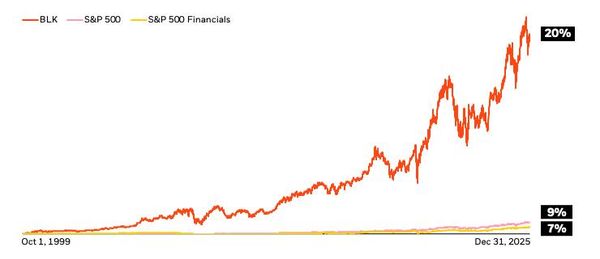
Source: S&P Global as of December 31, 2025. The performance graph is not necessarily indicative of future investment performance.
Our growth and success begin with our world-class talent, and our leadership team is no exception. In 2025, we expanded our Global Executive Committee to include more emerging enterprise leaders who will help advance our strategy in the years ahead. And in the last 18 months, we’ve welcomed an outstanding group of leaders from GIP, Preqin, and HPS. We have a long history of successful integrations, and a number of our current senior leaders joined us through acquisitions. We’re already benefiting from the fresh perspectives and experience of our new colleagues alongside our homegrown talent.
AI can be a powerful business accelerator for Aladdin, amplifying the strengths of its scale, deep resources, proprietary data, and extensive embedded network across the global investment ecosystem.
Our Board of Directors
BlackRock’s Board has long been an essential component of BlackRock’s growth and success. Their deep knowledge and strategic insight help shape our long-term strategy and inform the decisions that position us for the opportunities and challenges ahead.
Earlier this year, our Board appointed Gregg Lemkau, Co-Chief Executive Officer of BDT & MSD Partners. Gregg brings a wealth of experience in the financial services industry, and I believe his perspectives will be invaluable as we execute on the next phase of our growth.
Looking ahead
Today, BlackRock is positioned at the intersection of the most powerful forces reshaping global finance: the long-term growth of the capital markets, the modernization of portfolios, the expansion of private investment, the evolution of AI, and the digital transformation of investing itself. Our diversified platform means we can meet clients wherever market opportunities align with their portfolio objectives—and do so profitably, responsibly, and at scale.
This is why we believe it is a compelling time to be a BlackRock shareholder. We enter 2026 with strong organic growth, a resilient earnings base, and multiple structural tailwinds working in our favor. Our strategy is clear. Our balance sheet is strong. And our purpose—to help more people experience financial well-being—continues to guide how we grow.
BlackRock has always been built for the long term. The results of 2025, and the momentum we’re seeing today, reinforce our confidence in the years ahead.
Our strategy is clear. Our balance sheet is strong. And our purpose—to help more people experience financial well-being—continues to guide how we grow.
Thank you
Finally, I want to say a profound “thank you” to everybody at BlackRock. When we founded this company 38 years ago, we hoped that someday we might be able to recruit the best minds in the financial sector to join us. We did. And after nearly four decades at BlackRock, the people are the reason I still love coming to work. So, to all my BlackRock colleagues, I’m so grateful for you.
And to BlackRock’s clients: Thank you for your trust. We know choosing someone to manage your money is a sacred thing, and we don’t take it for granted. Serving you is a real privilege.
Sincerely,

Laurence Fink
Chairman and Chief Executive Officer
Building America: investing in infrastructure and the workforce
America needs $10 trillion in infrastructure investment. This paper explores the opportunity to build the labor force needed to deliver it and how apprenticeships and partnerships can expand access to resilient, well-paid careers.
Tokenization could transform finance, write Larry Fink & Rob Goldstein
Larry Fink and Rob Goldstein write in The Economist on why they see tokenization as a bridge between traditional and digital markets that can make capital move faster, safer, and more broadly.