Jean Boivin
Head — BlackRock Investment Institute
AI under pressure
Investor scrutiny of AI is intensifying this earnings season. How results hold up will be key to our broader medium-term conviction in the AI transformation.
Market Backdrop
The Nasdaq posted its worst month since March 2025 as AI scrutiny intensified. We see multiple plausible outcomes for growth, profitability and returns.
Week Ahead
We are watching October U.S. jobs data amid signs of a tight labor market in recent months. Any further wage pressure could drive core services inflation.
Four years of booming AI investment have sent earnings expectations soaring. Investors now want evidence that spending can deliver returns, especially as rising capital expenditures squeeze free cash flow, pushing it into negative territory for some firms. We recently downgraded U.S. equities to neutral to lock in profits, but our core conviction in the AI transformation remains intact. That supports our EM equity overweight through exposure to bottlenecks in the AI buildout.
Year-over-year earnings growth for S&P 500 companies, 2026
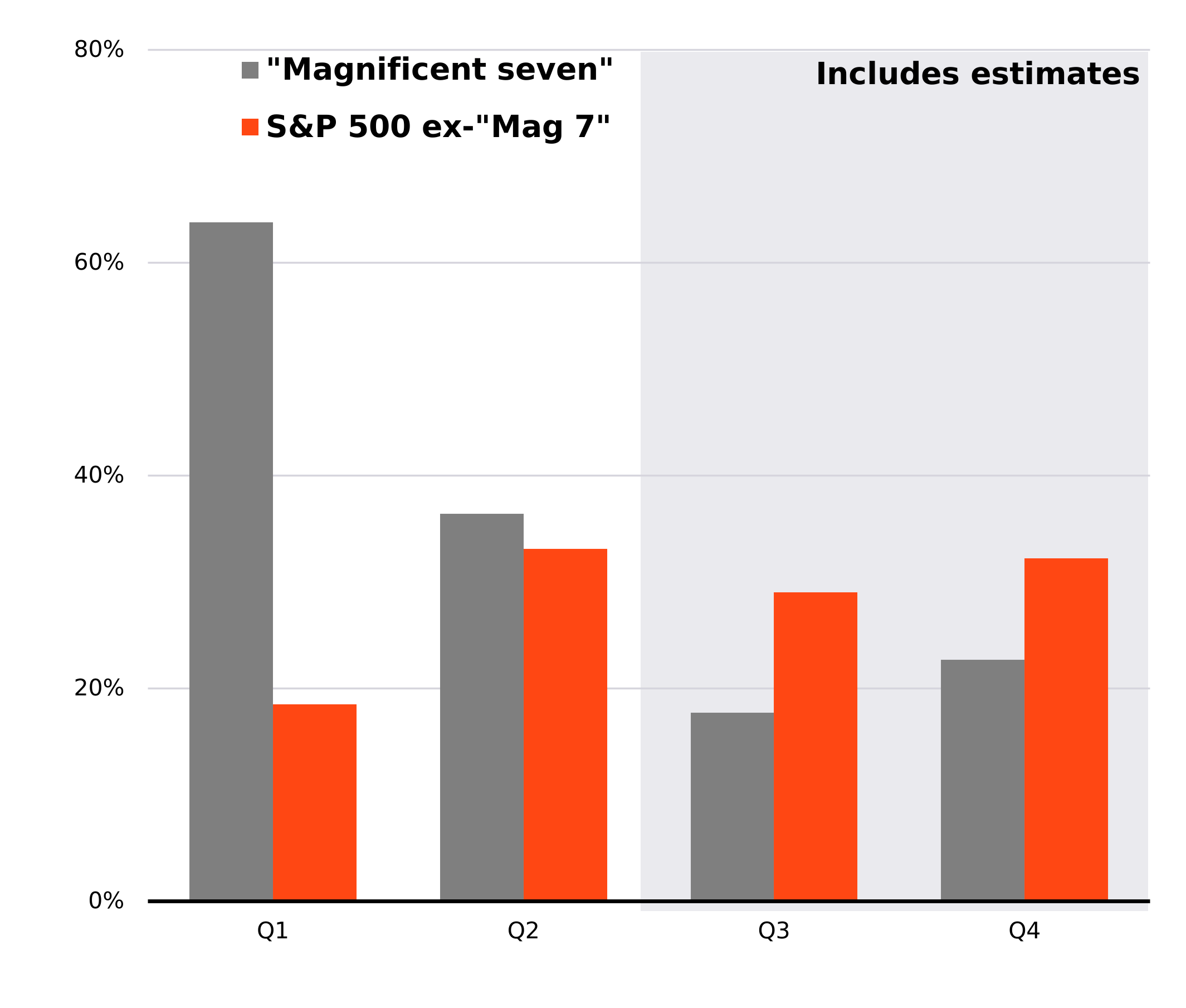
Past performance is not a reliable indicator of future results. Forward-looking estimates may not come to pass. Source: BlackRock Investment Institute, with data from Bloomberg, October 2026. Note: The bars show year-over-year earnings per share growth for the “magnificent seven” stocks (Alphabet, Amazon, Apple, Meta, Microsoft, Nvidia and Tesla) and the rest of S&P 500. Figures for Q3 and Q4 include estimates.
We will learn much more about the AI theme this earnings season, especially how impactful the technology will ultimately be. But the backdrop for mega-cap tech stocks is starkly different from just four months ago. After narrowing considerably earlier this year, the earnings growth gap has now flipped for the first time since 2022, with the S&P 493 outpacing the “magnificent seven” at roughly 29% versus 18%. See the chart. The bar remains high. Consensus expects S&P 500 earnings to grow about 30% – marking a third consecutive quarter of growth above 20% – according to LSEG data. Meanwhile, scrutiny of the AI theme has grown. That shifting backdrop contributed to our decision to downgrade U.S. equities to neutral last month. Our conviction in AI fundamentals, however, remains intact.
Last week’s earnings highlighted a growing tension between strong demand for AI-linked goods and services and the rising cost of meeting it. Hyperscaler capital spending has surged to about $649 billion over the past year, from about $357 billion in the prior-year period, according to data from Bloomberg, leaving little cash surplus after capex. And while hyperscalers’ operating margins have edged up to 27.1% from 26.9% in the previous four quarters, incremental margins have fallen to 27.9% from 40.4% over that same period. In other words, each additional dollar of revenue is generating less additional profit, raising questions about whether returns can keep pace with soaring investment. Still, our analysis finds that companies with higher AI adoption outside the S&P 500 technology and communication sectors are on track for 3% higher earnings growth this quarter than lower adopters, based on evidence of AI use in regulatory filings. Cloud revenue growth at Microsoft and Alphabet also points to sustained momentum in AI demand. But whether that demand will be enough to justify the scale of investment is still an open question, one we plan to debate at our 2027 internal Outlook Forum this week.
As the AI buildout becomes increasingly debt-financed, leverage and differences in funding capacity are coming into sharper focus. Credit markets are becoming an important signpost of how much additional AI investment can be financed and at what cost. The Treasury rally alongside the tech sell-off this week also fits our view that the ebb and flow of AI investment expectations will drive competition for capital and bond yields around structurally higher levels.
Within equities, we’re selective with our AI exposures. We favor companies and listed infrastructure poised to benefit from the critical bottlenecks in the AI buildout, a key reason for our move back to overweight EM equities in September. We see that opportunity playing out in Asia. Recent results from chipmakers point to tight supply and strong AI demand. But staying nimble is crucial, as our EM positioning shows: we upgraded at the start of the year, took profits midyear and returned to overweight in September. Brazil’s post-election selloff bears watching, but it does not change our EM overweight.
AI faces a tougher near-term test as investor scrutiny intensifies. But our conviction in AI fundamentals remains intact, keeping us selective on where we take AI exposure while favoring opportunities tied to scarcity in the buildout.
The Nasdaq Composite capped its worst month since March 2025 as concerns over returns on massive AI spending intensified. The key question now is the economic value of the AI buildout: what returns it generates and who captures them. We see a range of possible outcomes for growth, profitability and returns on this investment. U.S. Treasuries extended their rally last week, with 10-year yields falling nearly 6 basis points to 4.93% after the Fed kept rates unchanged, as expected.
We focus on October nonfarm payrolls for signs of a tightening labor market and what that could mean for inflation. We’d expect stronger wage pressures than in recent jobs reports, potentially adding to core services inflation, making the October jobs data key to assessing our view of price pressures.
Nov. 2
Global manufacturing PMI final
Nov. 4
U.S. international trade balance
Nov. 5
Bank of England interest rate decision
Nov. 6
U.S. Oct. jobs report; Umich consumer sentiment
Read our past weekly market commentaries here
Since we launched our mega forces framework, it has become clearer how their intersection shapes almost all our investment views and opens up alpha opportunities. They cut across asset class labels, spurring a rethink of portfolio construction. Investors need to be deliberate about the economic or thematic exposures they own, the vehicles they use to implement them and their investment horizons.
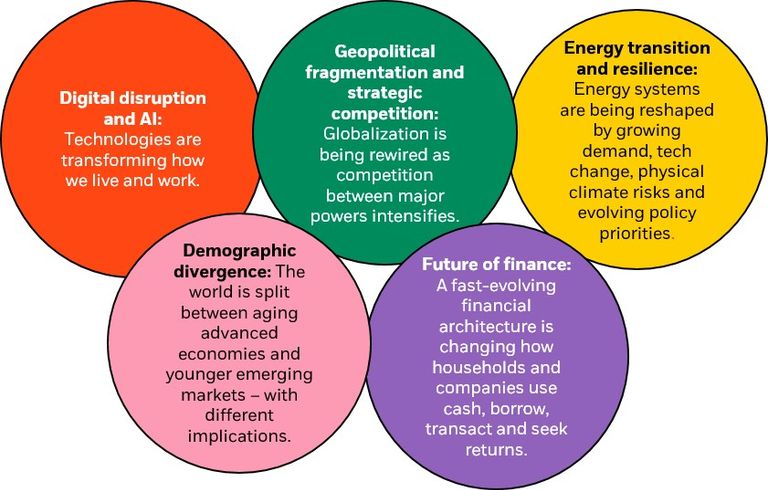
Our highest conviction views, November 2026
Note: Views are from a U.S. dollar perspective, November 2026. This material represents an assessment of the market environment at a specific time and is not intended to be a forecast of future events or a guarantee of future results. This information should not be relied upon by the reader as research or investment advice regarding any particular funds, strategy or security.
Six- to 12-month tactical positioning, November 2026
This shows the implementation of our key investment views from the previous page through an asset class lens.

Past performance is not a reliable indicator of current or future results. It is not possible to invest directly in an index. Note: Views are from a U.S. dollar perspective. This material represents an assessment of the market environment at a specific time and is not intended to be a forecast or guarantee of future results. This information should not be relied upon as investment advice regarding any particular fund, strategy or security.
Six to 12-month tactical views on selected assets vs. broad global asset classes by level of conviction, November 2026
We have lengthened our tactical investment horizon back to six to 12 months. The table below reflects this and, importantly, leaves aside the opportunity for alpha, or the potential to generate above-benchmark returns – especially at a time of heightened volatility.
Past performance is not a reliable indicator of current or future results. It is not possible to invest directly in an index. Note: Views are from a euro perspective, November 2026. This material represents an assessment of the market environment at a specific time and is not intended to be a forecast or guarantee of future results. This information should not be relied upon as investment advice regarding any particular fund, strategy or security.

Stay informed on our latest weekly Market take. Listen wherever you get your podcasts.