Please read this page before proceeding, as it explains certain restrictions imposed by law on the distribution of this information and the jurisdictions in which our products and services are authorised to be offered or sold. It is your responsibility to be aware of and to observe all applicable laws and regulations of any relevant jurisdiction.
By entering this site you are agreeing that you have reviewed and agreed to the terms contained herein, including any legal or regulatory restrictions, the Privacy Notice, which explains how we collect, use, and disclose your personal information and how it is protected, and the Cookie Notice, which explains how we use cookies on our sites.
By confirming that you have read this important information, you also:
(i) agree that all access to this website by you will be subject to the disclaimer, risk warnings and other information set out herein; and
(ii) agree that you are the relevant sophistication level and/or type of audience intended for your respective country or jurisdiction identified below.
The information contained on this website (this “Website”) (including without limitation the information, functions and documents posted herein (together, the “Contents”) is made available for informational purposes only.
No Offer
The Contents have been prepared without regard to the investment objectives, financial situation, or means of any person or entity, and the Website is not soliciting any action based upon them.
This material should not be construed as investment advice or a recommendation or an offer or solicitation to buy or sell securities and does not constitute an offer or solicitation in any jurisdiction where or to any persons to whom it would be unauthorized or unlawful to do so.
Access Subject to Local Restrictions
The Website is intended for the following audiences in each respective country or region: In the U.S., institutional investors. In Canada, institutional investors. In the UK, professional clients (as defined by the Financial Conduct Authority or MiFID Rules) and qualified investors only and should not be relied upon by any other persons. In the EEA, professional clients, professional investors, qualified clients and qualified investors. For qualified investors in Switzerland: This information is marketing material. This material shall be exclusively made available to, and directed at, qualified investors as defined in Article 10 (3) of the CISA of 23 June 2006, as amended, at the exclusion of qualified investors with an opting-out pursuant to Art. 5 (1) of the Swiss Federal Act on Financial Services ("FinSA"). For information on art. 8 / 9 Financial Services Act (FinSA) and on your client segmentation under art. 4 FinSA, please see the following website: www.blackrock.com/finsa. In Singapore, for Institutional Investor only as defined in Section 4A of the Securities and Futures Act, Chapter 289 of Singapore. In Hong Kong, for professional Investor only (as defined in the Securities and Futures Ordinance (Cap.571 of the Laws of Hong Kong) and any rules made under that ordinance). In Japan, Professional Investors only (Professional Investor is defined in Financial Instruments and Exchange Act). In Australia, for wholesale clients only as defined in the Australian Corporations Act 2001 (Cth). In Brunei, Indonesia, and Malaysia, Institutional Investors only. In Latin America, institutional investors and financial intermediaries only (not for public distribution). In Mexico, institutional and qualified investors only (not for public distribution). In South Africa, a provider who provides products or services to a client other than financial products or financial services, must disclose to the client the fact that the additional products or services are not regulated under the Act and therefore the client is not afforded the same protections in respect of those additional products or services that may apply in respect of the provision of financial products or services in terms of the Act.
This website and its content are not intended for, or directed to, persons in any countries or jurisdictions that are not enumerated above, or to an audience other than as specified above.
This Website has not been, and will not be submitted to become, approved/verified by, or registered with, any relevant government authorities under the local laws. This Website is not intended for and should not be accessed by persons located or resident in any jurisdiction where (by reason of that person's nationality, domicile, residence or otherwise) the publication or availability of this Website is prohibited or contrary to local law or regulation or would subject any BlackRock entity to any registration or licensing requirements in such jurisdiction.
It is your responsibility to be aware of, to obtain all relevant regulatory approvals, licenses, verifications and/or registrations under, and to observe all applicable laws and regulations of any relevant jurisdiction in connection with your access. If you are unsure about the meaning of any of the information provided, please consult your financial or other professional adviser.
No Warranty
The Contents are published in good faith but no advice, representation or warranty, express or implied, is made by BlackRock or by any person as to its adequacy, accuracy, completeness, reasonableness or that it is fit for your particular purpose, and it should not be relied on as such. The Contents do not purport to be complete and are subject to change. You acknowledge that certain information contained in this Website supplied by third parties may be incorrect or incomplete, and such information is provided on an "AS IS" basis. We reserve the right to change, modify, add, or delete, any content and the terms of use of this Website without notice. Users are advised to periodically review the contents of this Website to be familiar with any modifications. The Website has not made, and expressly disclaims, any representations with respect to any forward-looking statements. By their nature, forward-looking statements are subject to numerous assumptions, risks and uncertainties because they relate to events and depend on circumstances that may or may not occur in the future.
No information on this Website constitutes business, financial, investment, trading, tax, legal, regulatory, accounting or any other advice. If you are unsure about the meaning of any information provided, please consult your financial or other professional adviser.
No Liability
BlackRock shall have no liability for any loss or damage arising in connection with this Website or out of the use, inability to use or reliance on the Contents by any person, including without limitation, any loss of profit or any other damage, direct or consequential, regardless of whether they arise from contractual or tort (including negligence) or whether BlackRock has foreseen such possibility, except where such exclusion or limitation contravenes the applicable law.
You may leave this Website when you access certain links on this Website. BlackRock has not examined any of these websites and does not assume any responsibility for the contents of such websites nor the services, products or items offered through such websites.
Intellectual Property Rights
Copyright, trademark and other forms of proprietary rights protect the Contents of this Website. All Contents are owned or controlled by BlackRock or the party credited as the provider of the Content. Except as expressly provided herein, nothing in this Website should be considered as granting any license or right under any copyright, patent or trademark or other intellectual property rights of BlackRock or any third party.
This Website is for your personal use. As a user, you must not sell, copy, publish, distribute, transfer, modify, display, reproduce, and/or create any derivative works from the information or software on this Website. You must not redeliver any of the pages, text, images, or content of this Website using "framing" or similar technology. Systematic retrieval of content from this Website to create or compile, directly or indirectly, a collection, compilation, database or directory (whether through robots, spiders, automatic devices or manual processes) or creating links to this Website is strictly prohibited. You acknowledge that you have no right to use the content of this Website in any other manner.
Additional Information
Investment involves risks. Past performance is not a guide to future performance. The value of investments and the income from them can fall as well as rise and is not guaranteed. You may not get back the amount originally invested. Changes in the rates of exchange between currencies may cause the value of investments to diminish or increase.

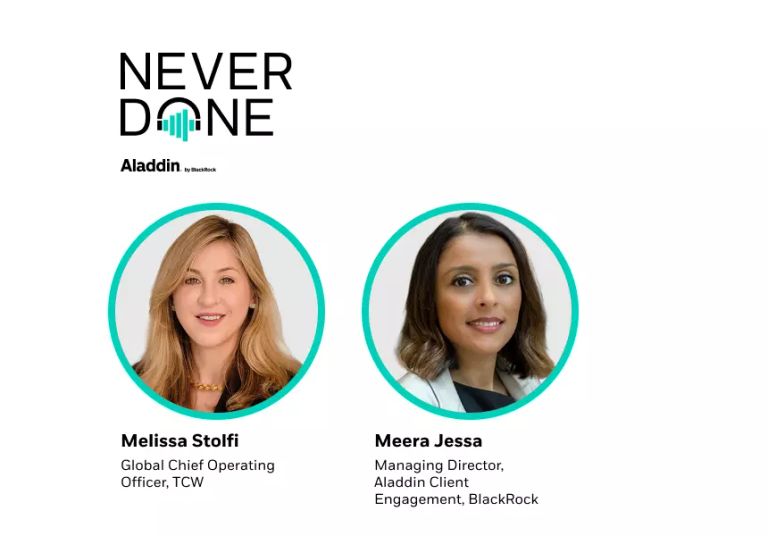
Melissa Stolfi, Global COO at TCW, and Meera Jessa, discuss how TCW is modernizing its operating platform through technology and strategic partnerships to drive growth. Against a backdrop of market volatility, Melissa outlines the firm’s expansion into private markets and its evolution toward a whole portfolio approach to drive long-term growth.
[MEERA JESSA]
Melissa, I feel like you were the first person I asked to join this podcast before it was even a thing. So, I cannot tell you, I'm like, jumping out of my seat, but you're finally here. A snowstorm came in our way. A blizzard. And we did it. We're finally making this happen on April Fool's nonetheless.
[MELISSA STOLFI]
Yes. This is real. We're actually doing this.
[MEERA JESSA]
Before we get started in the conversation. I know you're a big foodie.
[MELISSA STOLFI]
I am a big foodie. Yeah.
[MEERA JESSA]
Tell me, what's a good new restaurant you've been to lately?
[MELISSA STOLFI]
Oh, gosh. I was in Mexico City earlier this year and went to a great restaurant there. The food scene in Mexico City is amazing. It was a new restaurant that just opened up. I'll have to think of the name, but it was delicious. But I have to say New York has a great food scene, so every time I'm back here, I love to go to all the great restaurants, especially downtown. So, it's a treat being here.
[MEERA JESSA]
So much like the New York food scene, I would say where restaurants come and go. Some are fleeting, even when they're great around the corner and you really enjoy going to them. And you go there the following week and it's closed down. It's really gut wrenching.
[MELISSA STOLFI]
It is.
[MEERA JESSA]
Our markets are quite the same right now. Things are shifting rapidly, so not just in the way the operating model works today, but if we think about what's happened in the last couple of weeks in private credit. If you look at the changing landscape, everything that's happening, the geopolitical environment, how do you define the moment that we're in right now?
[MELISSA STOLFI]
I think we're in a transitional moment right now for markets, and we're seeing a lot of volatility, which for an active manager is actually our friend and something we've been waiting for and are well prepared to navigate. I think if you are with a manager who has experience that is tested, you will be well positioned to navigate these markets and actually come out better on the other side because you can take advantage of these dislocation market opportunities. We've seen over the course of the last several years, equity valuations being at all-time highs.
[MEERA JESSA]
Right.
[MELISSA STOLFI]
That's been very much led by the Mag Seven. And then in bond markets, yields and spreads that are very tight. And that creates difficult entry points sometimes for clients. So, these types of market dislocations do open us up for a tremendous amount of opportunity.
Maybe taking a step back. We at TCW, we're about a $200 billion asset manager. We manage assets across both public and private markets, and we have a 50-year heritage of investing across these asset classes and serving clients. We talk a little bit about asset management and the importance of scale. We are large enough to have scale, but also small enough and nimble enough to be able to quickly react to these market opportunities.
And then in terms of our size, we're also able to prosecute against a lot of our strategic initiatives in a very clear, focused and deliberate way. And I would say I see that theme play out very predominantly on the infrastructure side of our business, across technology and operations. And I think we're going to talk about this later on in the podcast.
But we've undergone some strategic transformational changes across our operating platform, and I don't think we could have done it with the amount of speed and precision if we were trying to operate across maybe an organization that was hundreds of thousands of people. You know, we're about 700 people, and we were able to select some key strategic initiatives that we wanted to go after and really execute on those maniacally. And I think that's what makes our size and our scale, in my mind, a competitive advantage.
[MEERA JESSA]
I love to hear that. You talked a little bit about the TCW strategy. How do you apply that to your clients’ needs and the long-term strategy of your firm? So, for example, here at BlackRock we talk a lot about the whole portfolio. I would love to hear your thoughts on where you see the opportunity set in the long term versus all the short-term volatility and different events we're seeing happen. Can you talk to me a little bit about TCW and how you've gone from your heritage business and evolving into the private market space?
[MELISSA STOLFI]
So, at TCW, our heritage and really our DNA is in fixed income investing. And that remains a key priority for us and our clients. One of the things that we've also been focused on is diversifying the business into credit alternatives. And there's really a couple reasons, from a macro perspective, that we've been focused on doing that. I would say big picture from a supply and demand standpoint.
On the demand side, we're seeing clients under-allocated to private markets. And as they rebalance their strategic asset allocation, we're seeing more private market capabilities come into that. There's been a lot of capital flowing into that space. Now it's about 20 trillion in AUM. Probably going to 30 trillion in AUM.
And then on the supply side, a lot of the deals that we previously saw that were financed in the public markets have transitioned to the private markets.
And therefore, in order to take advantage of that, you need to have investment teams and investment capabilities that invest across both public and private. I would also say at TCW, we believe we have a right to win in the private market space, given we've been taking private stakes in companies in our fixed income business for over 30 years.
And then also inside of the walls of TCW, we've been operating a private credit business for over 12 years, and that particular business has a 25-year track record. So, we have some length of time and some experience in managing these private market assets. So, a lot of our strategy has really been allocating more capital to the private markets businesses and working to expand capabilities and offerings for clients there, and really just bringing more brand awareness to those teams’ functionalities and capabilities.
And we're well on our way in achieving success there. Over the course of the last four years, we've more than doubled assets in our private markets business, and we now manage about $23 billion of committed capital. And we're doing that across three main investment verticals: CLO, direct lending, and asset-backed financing. One of the most interesting parts of the market, and what I would call the next frontier to private credit, is asset-backed financing, or ABF.
And that's a business we stood up about two years ago and we're now $3 billion of committed capital. So, we've scaled that very, very quickly. And that presents a meaningfully larger market opportunity than direct lending. So, direct lending’s TAM is about $1.8 trillion—while asset backed financing is about a TAM of $20 trillion. So, it's pretty significant in terms of size.
And when you think about asset-backed financing, it really is the financing that supports the everyday economy, that supports small businesses and consumers. So, think the things that you use in your daily life, credit card, auto lending, mortgages, those are all aspects of your daily life that are financed through these private markets. So, there's a tremendous opportunity there, and we've dedicated a lot of resources and capital to growing that business.
We've actually stood it up side-by-side with our securitized business, and we have our securitized team working very closely with our asset-backed financing team so that they can speak to a lot of these transactions being done in the private markets, and they can work with CFOs to provide either private market financing or public market financing, and really speak to the whole capital structure. Additionally, having the teams sit side-by-side enables us to take advantage of relative value opportunities that exist across the continuum of public and private markets.
[MEERA JESSA]
That's really interesting. And the comment around you saying the team sitting side-by-side was actually curious because TCW’s heritage has always been fixed income. Since you've joined, and Katie and others have joined the firm, you've made tremendous strides in many different things. How was it transforming that culture shift?
[MELISSA STOLFI]
I think as I said, we have had these capabilities in the business—so, this is really just about emphasizing them, giving them the capital to grow and really focusing on them. One of the things that we've talked about with our investment teams is that really a rising tide raises all ships. The entire organization is focused on growth, and that's built into our culture, built into our DNA.
So, I think people are really excited to see how they can work with other teams to help their individual growth and their teams growth, but also help build out new business lines and new vectors that we can offer clients. I think it makes the organization holistically stronger when we can go to market and offer clients a more comprehensive portfolio.
So instead of being able to just offer dedicated public market products, we now have the opportunity to provide the total portfolio allocation and fill that other part of their asset allocation bucket, which is exceedingly becoming private markets.
[MEERA JESSA]
Right. So, I want to come back to something you said around your technology and operation transformation. I had read something through a McKinsey study around transformations can increase efficiency by 30% within a firm and help you de-risk operating events and give you the ability to grow at a more rapid pace and scale in the future.
When you look at your digital transformation journey, how did you come about thinking through, well, these are the things that give us operational alpha and we want to keep in-house versus this is where we're going to partner? Because when I look at you as a firm, I think you have made incredibly strategic decisions around this, and I would love to hear your thought process and how you came about this.
[MELISSA STOLFI]
So, that's a great question. So, we just underwent a significant transformation of our operating platform, really to position the business for growth. We needed to have a strong foundation for this next chapter in TCW’s journey. And as you said, our strategy really has been to partner with best-in-class service providers and vendors and experts in the area, not only from a technology standpoint, but also on the operational side. And I think one of the important things that we recognize at TCW is our core competency is investing and delivering clients on the stated investment objective that we've agreed to, and we're focused on executing on that objective with excellence.
So really our strategy has been to partner with best-in-class service providers. And we've really seen this be the trend across the industry. As I speak to COOs at other organizations, other mid-size asset managers, even large asset managers, this is the playbook and the strategy that they're running. And so, when we talk about scale and efficiency, the opportunity to partner really drives that and allows us to divert resources to areas of the business that we believe we can add more value.
With respect to our strategy with vendors, though, a lot of these tools, we're not just leveraging them out of the box. There are certain applications from a technology and operational perspective that we need to maintain in-house to serve our clients, and to also support our proprietary investment process. And so that's been an important part of our technology roadmap.
So, we're still going to maintain certain systems that are core to the things that we do at TCW and we believe they give us an edge. But BlackRock has been a great partner in really helping us customize Aladdin and utilize that platform alongside some of these proprietary tools. But big picture stepping back, we did decide from an efficiency standpoint to use Aladdin front-to-back across the organization. So, we're using it from everything from trading, portfolio management, risk and compliance.
And we found that is the most seamless way to manage the business and to really build a foundation for growth and have technology that operates relatively seamlessly. And then I think we're also going to talk about AI, which was an exciting space later on in this conversation.
[MEERA JESSA]
You actually beat me to it because that was going to be my next question.