Tokenisation has been garnering considerable attention for what it presents: the prospect of a transformation of the financial ecosystem – an evolution that could make global financial markets more connected, accessible and efficient.
Key points
01.
Tokenisation is a new “digital wrapper” for assets
Tokenisation enables the blockchain to record ownership or exposure to assets as digital tokens, allowing them to be programmed, traded, settled and recorded on a blockchain, while not changing the underlying asset itself.
02.
Adoption is early but growing
Adoption is led by use cases such as stablecoins and tokenised treasury funds, with increasing interest from traditional finance as interoperability improves.
03.
Tokenisation introduces both opportunities and challenges
Tokenisation can enhance market efficiency, transparency, and access, but does not eliminate investment risks and requires evolution in regulation and infrastructure to scale.

How tokenisation could transform finance
Larry Fink and Rob Goldstein write in The Economist on why they see tokenisation as a bridge between traditional and digital markets that can make capital move faster, safer, and more broadly.
The tokenisation basics
What is tokenisation?
Tokenisation is a way to utilize blockchains to record ownership of, or exposure to, assets as digital tokens, allowing them to be programmed, traded, settled and recorded on blockchain.
At its core, tokenisation is a modern file format in which assets are digitally represented on blockchains. It changes how ownership and exposure are recorded and transferred, not what the underlying assets are — ultimately enabling more streamlined transfer and management of assets, greater programmability, and broader investor access.
Today, tokens fall into two broad categories:
- Tokenised price representations (TPRs) are designed to provide economic exposure to an underlying asset (i.e., participation in the price movements and distributions)
- Tokenised ownership conveys actual asset ownership (i.e., economic exposure and beneficial ownership rights, like voting).
Is Tokenisation the Next Financial Evolution? ft Rob Goldstein
Financial market infrastructure is often invisible to investors, yet it powers every trade, settlement, and ownership record across capital markets. As technology evolves, tokenisation is emerging as a new way to represent and transfer financial assets, raising questions about how markets may operate in the future.
What does tokenisation solve?
Tokenisation has the potential to transform how financial assets are accessed and exchanged through blockchain technology.
As global markets become more digital and continuous in nature, tokenisation offers opportunities to enhance certain attributes of the traditional market infrastructure such as:
- 24/7 trading
- Near instantaneous settlement
- Transparency and auditability
- Reduced operational friction through digitisation
- Interoperability across platforms (i.e., blockchains, exchanges, custody providers)
- “Programmability" or automation of administrative functions (i.e., transfer of ownership)
- Fractional ownership (similar to ETFs)
- Access to investment products within new markets
While tokenisation allows for a new digital representation, it does not inherently create liquidity, mitigate investment risks, or remove the need for investor protection.
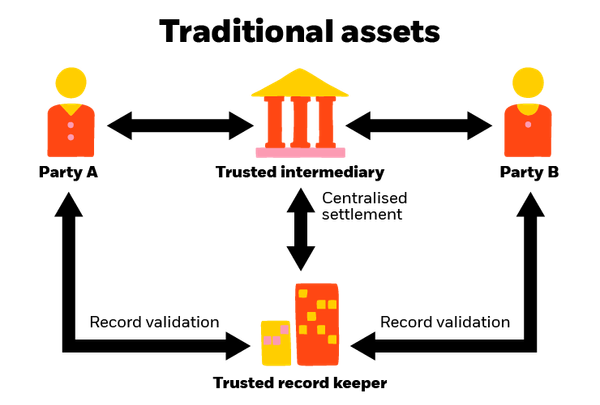
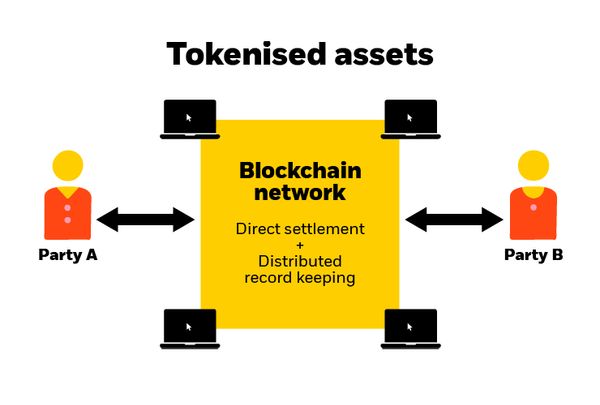
How do tokens and tokenisation fit into the digital asset universe?
Digital assets is an umbrella term for assets that exist in digital format and are recorded, transferred, and managed on blockchain, including cryptoassets (e.g., bitcoin, ether), stablecoins, and tokenised assets.
Cryptoassets are digitally native assets issued on blockchains, relying on this technology to regulate the generation of new units, verify transactions, and secure records of ownership without the need for a centralized authority or intermediaries.
Because tokenisation enables assets to move on digital rails, investors who prefer the token wrapper might choose to access traditional assets (e.g., broad equity, bonds, t-bills) via a tokenised version.
What is blockchain? What role does blockchain play in tokenisation?
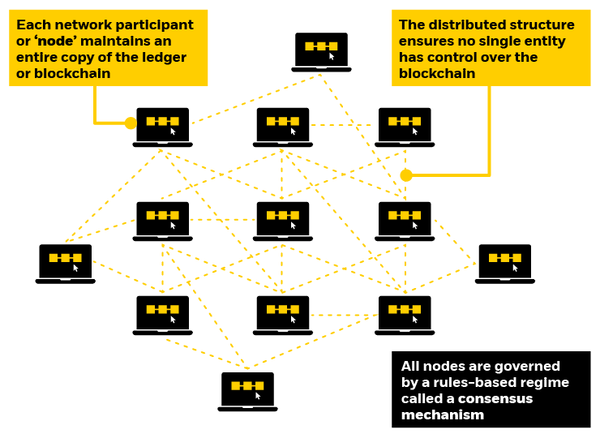
Blockchain is digital ledger where transactions are maintained by a network of computers often without a central authority. This enables investors, who typically participate in financial markets directly on-chain, to verify and update ownership without relying on multiple disconnected systems.
On-chain refers to assets that are written into the shared blockchain record, with all transactors using the blockchain to see and verify transactions (such as a token transfer or ownership of a crypto asset), and the blockchain itself enforces the rules.
Blockchain acts as the infrastructure layer that enables tokenised assets to be transferred and settled more efficiently, while allowing certain rules (e.g., transfer restrictions or distributions) to be embedded and enforced through code.
The core innovation of blockchain technology (whether public or private) is its ability to establish trust and ensure data integrity and security through code and cryptography.
A public blockchain network provides a distributed synchronized record of truth that anyone can access or validate, where transactions are recorded transparently and secured through decentralized consensus rather than a central authority. This enables transactions to happen between disparate parties without facilitation by a centralized intermediary.
A private blockchain, on the other hand, is a restricted distributed ledger governed by a centralized organisation, where only approved participants can access or validate transactions. It emphasizes controlled access and governance among known participants.
What are the risks associated with tokenised assets?
Tokenisation can be thought of as a new file format for assets, however it does not eliminate the traditional risks of investing; it introduces both new technological, operational, regulatory and market structure considerations.
Immutability
Public blockchains are typically immutable by design, meaning a transaction cannot be cancelled or reverted once settled. Although this is a critical feature, it increases the importance of upfront controls and operational safeguards.
Smart contract risk
Smart contracts, or self-executing code that automates transactions based on predefined rules, are based on relatively novel technology and may contain bugs or vulnerabilities, which can result in loss of assets or unintended outcomes if not properly audited and monitored.
Regulatory uncertainty
The legal and regulatory treatment of tokenised assets continues to evolve. Key considerations include how tokens are classified, what rights they provide, and which rules apply to issuance, trading, custody, settlement, servicing, tax, and disclosure.
Novel processes and new ecosystem participants
Engagement with blockchain infrastructure requires new processes which are not “standard” to many existing traditional market participants. These processes may involve newer digital asset service providers alongside existing markets participants, creating different considerations for how transactions are processed, recorded, and safeguarded.
What are the main tokenised asset categories emerging today?
Investors have coalesced around two asset classes: stablecoins and tokenised treasury funds
Designed to maintain a stable value by pegging their price to a reference asset, using reserve backing to minimize volatility without relying on traditional intermediaries. Consider stablecoins as a digital representation of cash, not an investment.
Utility
Investors primarily use stablecoins as a settlement asset in cryptoasset trading. This enables investors to fund trades, move between assets and hold value between transactions. Stablecoin volume is now outpacing cryptoasset trading, potentially pointing to uptake in other use cases, such as payments.
Adoption
One of the largest digital assets that has shown product-market fit (~$300B market cap)1
A treasury fund in which asset ownership is represented by digital tokens on the blockchain. This enables investors to earn U.S. dollar yields on blockchain rails.
Utility
Investors initially utilized tokenised short-term US Treasuries to inject a yield layer into their cash management strategies. Tokenised treasury funds’ utility compounds when interoperable with stablecoins, providing frictionless yield and driving demand through more flexible use of capital.
Adoption
Seeing recent market traction, but remains a small fraction of the overall market ($15B+ market cap).
The equity markets are beginning to experiment with issuances of tokenised price representations, designed to provide economic exposure to underlying stocks and ETFs.
We do not currently see other asset classes reaching meaningful scale or real product-market fit.
What are the challenges on the path to tokenisation adoption?
Tokenisation adoption faces several challenges, including regulatory uncertainty on the application of existing frameworks to tokenised assets, limited infrastructure and liquidity, switching costs for new investors, security and operational considerations, and potential market fragmentation.
- Regulation: Existing regulatory frameworks were designed for traditional market structure and continue to evolve to address the novel attributes of tokenisation. Navigating different regulatory treatment between jurisdictions is a challenge where tokenised assets exist on blockchains that are borderless.
- Distribution and liquidity: Most traditional finance platforms generally do not yet have the infrastructure to support tokenised asset trading, though early pilots and capability builds are underway.
- Switching costs: Traditional investors, mainly in developed markets, already access these assets off chain and at relatively low cost. They will require decisive net benefits to justify a switch.
- Security: Open blockchain networks introduce a new security paradigm for investors, where ownership is controlled through digital keys rather than traditional intermediaries. This creates different risks around custody and access, and, in more complex use cases, smart contract vulnerabilities.
- 24x7 Trading: Traditional institutions need to rewire systems and processes to adapt to a different technical and operational model.
- Behavioral shift: Adoption requires changes in investor habits, processes, and trust frameworks.
- Market quality: Liquidity fragmentation may lead to wider spreads and higher premiums/discounts relative to traditional ETFs, and a fragmented experience for clients. Clear market structure and coordination between service providers can help mitigate this risk.
How might tokenisation affect capital markets in the long term?
Tokenisation may represent a practical next step in market modernization, making investing and the capital markets faster, cheaper, and more transparent, reducing friction and enabling assets to move more easily across systems.
As more asset classes move on-chain, tokenisation could reshape trading and liquidity networks, collateral management, and portfolio construction across cryptoassets and tokenised assets.
By enabling greater efficiency, programmability, and accessibility, tokenisation can broaden participation, unlock new distribution channels, and allow investors to engage with our products in formats that better meet their evolving needs.
Over time, tokenised and traditional assets may increasingly converge, with tokenisation becoming a more common format for issuing, recording and transferring financial assets.
Glossary2
1 RWA.xyz as of June 30, 2026
2 These terms reflect BlackRock’s taxonomy and are not anchored to regulatory or accounting definitions. BlackRock recognizes that different jurisdictions and regulators may have their own classification frameworks. BlackRock definitions are not tied to any proposed system.
This material is provided for educational purposes only and should not be construed as research. The opinions expressed herein are subject to change at any time due to changes in the market, the economic or regulatory environment or for other reasons. BlackRock does not render any legal, tax or accounting advice and the education and information contained in this material should not be construed as such. Please consult with a qualified professional for these types of advice.
The opinions expressed may change as subsequent conditions vary. The information and opinions contained in this material are derived from proprietary and non-proprietary sources deemed by BlackRock, Inc. and / or its subsidiaries (together, “BlackRock”) to be reliable. No representation is made that this information is accurate or complete. Reliance upon information in this material is at the sole discretion of the reader.
None of the information constitutes a recommendation by BlackRock, or an offer to sell, or a solicitation of any offer to buy or sell any securities, product or service. The information is not intended to provide investment advice. BlackRock does not guarantee the suitability of potential value of any particular investment. The information contained herein may not be relied upon by you in evaluating the merits of investing in any investment.
No part of this material may be reproduced, stored in any retrieval system or transmitted in any form or by any means, electronic, mechanical, recording or otherwise, without the prior written consent of BlackRock. This publication is not intended for distribution to, or use by any person or entity in any jurisdiction or country where such distribution or use would be contrary to local law or regulation.
©2026 BlackRock, Inc. or its affiliates. All rights reserved. BLACKROCK is a trademark of BlackRock, Inc. or its affiliates. All other marks are the property of their respective owners.
BlackRock®
As a global investment manager and fiduciary to our clients, our purpose at BlackRock is to help everyone experience financial well-being. Since 1999, we've been a leading provider of financial technology, and our clients turn to us for the solutions they need when planning for their most important goals.
© 2026 BlackRock, Inc. All Rights Reserved.
GPS0726-5764160-EXP0727