In recent years, Defined Contribution (DC) schemes have increased their integration of private market investments, driven by growing size, scale and sophistication to ultimately deliver higher quality defaults for their end members. Paired with a more favourable regulatory environment via the establishment of fund structures such as the Long Term Asset fund (“LTAF”), we believe the current landscape is well primed for DC schemes to consider investing in private markets.
The power of private markets in DC

Capital at risk. The value of investments and the income from them can fall as well as rise and are not guaranteed. Investors may not get back the amount originally invested.
Why private markets?
Access to growth
As private capital drives a growing share of economic activity, private markets are projected to reach US$20trillion by 2029¹, offering large potential growth to investors.
Enhanced returns and diversification
Private markets offer lower correlation to public markets, enabling investors to diversify their portfolios and unlock growth potential without increasing overall risk.
Inflation protection and income
Private markets offer inflation protection and income by providing resilient cash flows across market cycles, and an ability to maintain value when prices rise.
Why private markets for DC?
• Inadequacy in DC
Around 40% of DC savers are not on track for the Pensions UK Minimum Retirement Living Standard. Access to private markets could help through diversification and improved growth potential.
• DC features align with the private markets opportunity
UK DC schemes now manage over £600bn,2 giving them the scale to access private markets. The average 40-year investment horizon also means they support long-term strategies and tolerate illiquidity.
• Higher return potential
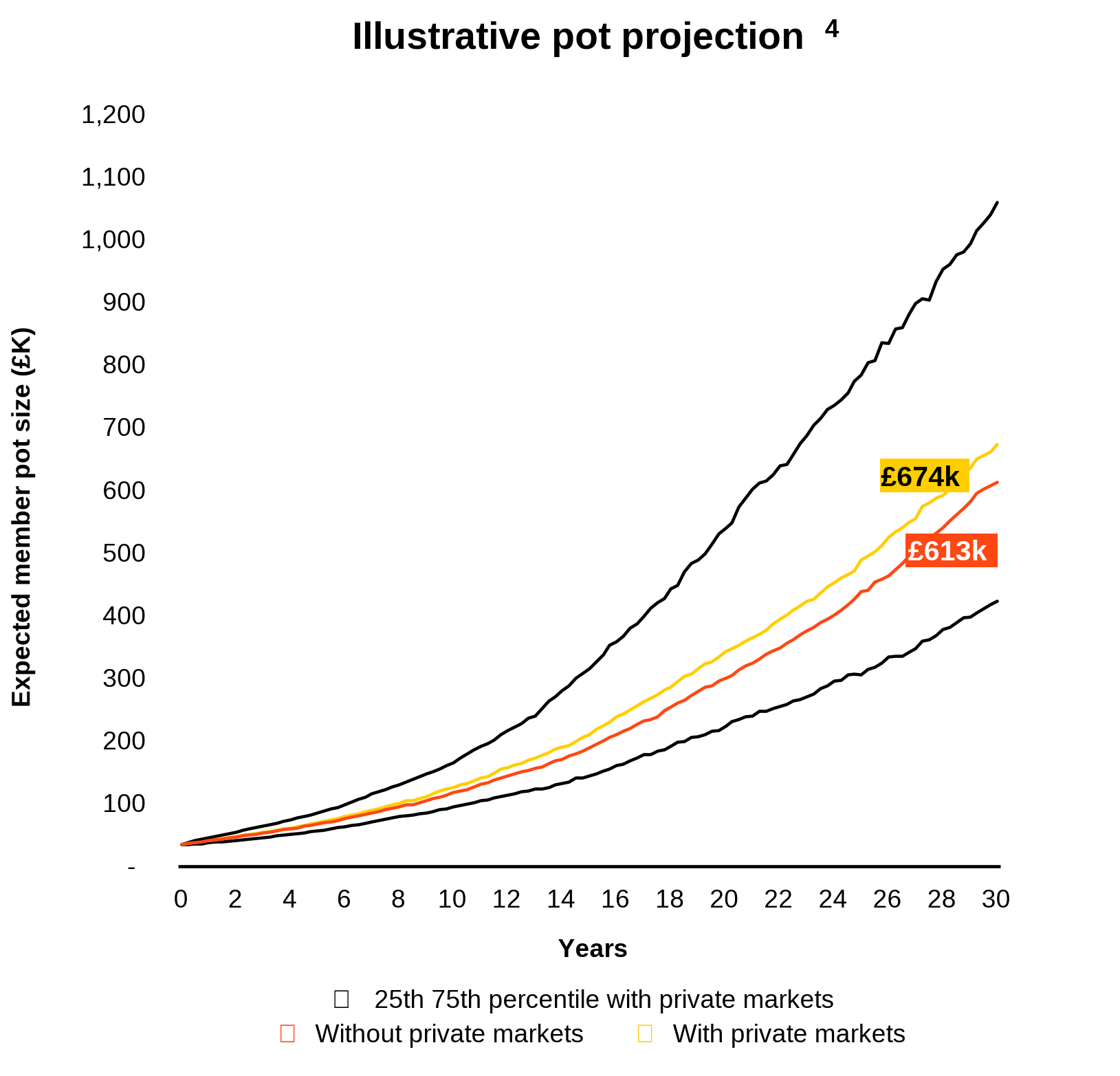
Private markets have historically delivered 3.5–6% higher risk-adjusted returns than public markets,3 driven by the illiquidity premium, active value creation and a broader opportunity set.
Long Term Asset Fund (LTAF)
The LTAF is a UK regulated vehicle for long-term assets. The vehicle has been designed with a diversified approach to alternatives in mind, aiming to improve DC member outcomes on both return and risk. The benefits of the LTAF wrapper include:
- Dynamic portfolio management. LTAFs are an open-ended vehicle, so DC schemes can build up their investment and contribute to the LTAF without the requirement to continually launch new funds.
- Allow investments in a wide range of private assets and mandates managers to own ‘long term’ investments meaning that members invest directly into private assets as opposed to liquid proxies.
- LTAFs are part of the ‘permitted link’ regime4 which supports defaults accessing the vehicle.
LTAF investment case studies
Evolve is a global logistics and freight-forwarding platform that helps businesses move complex, high-value and time-sensitive shipments around the world. It operates a full spectrum of forwarding services across an integrated air, road and ocean network; a combination that is uncommon in the industry. This network spans 158 stations globally, with a focus in the Americas (42% of stations) and Europe (36%) and an emerging presence across Asia, India and the Middle East (21%). BlackRock invested in April 2026 alongside a specialist logistics and industrials sponsor.
Investment Highlights
- Structural demand tailwind: Evolve is well positioned to benefit from increasing demand for specialised, time-sensitive logistics solutions, including the rapid expansion of data-centre and AI-related freight. As grid capacity, and next-generation GPUs unlock incremental build activity, scaled providers with established carrier programs and integrated networks stand to capture a disproportionate share of growth.
- Differentiated, integrated platform: Evolve offers a full spectrum of forwarding services with integrated capabilities across air, road and ocean, supported by a global network of 158 stations across the Americas, Europe and emerging markets.
- Strong commercial traction and revenue visibility: The company holds deep, embedded relationships with major hyperscale technology customers, providing future revenue visibility, alongside commercial momentum across additional large accounts that create room for further revenue gains.
- Multiple value-creation levers: The investment offers several avenues for value creation: organic expansion, strategic M&A and operational execution.
Evolve is a scaled, embedded provider to some of the world's largest technology customers, with meaningful exposure to the fast-growing data-centre logistics market. This is an area underpinned by the global build-out of AI compute infrastructure. U.S. data-centre freight spend is expected to experience strong growth in the coming years, which could disproportionately benefit established, certified platforms like Evolve.
Global logistics platforms of this scale and complexity typically create most of their value away from public markets. Building integrated air-to-road networks, securing carrier certifications and proving SLA performance requires patient capital, operational expertise and time ie conditions best suited to private ownership. Public markets rarely offer exposure to this phase of value creation, meaning much of the upside is captured before any listing. For defined contribution pension schemes, private market allocations are essential to access opportunities of this kind.
Why BlackRock?
01.
Established private markets platform
With $676bn in assets under management and $42bn in multi-alternative portfolios.5
02.
Technological and data capabilities
Providing greater transparency into the sources of risk and return and powered by industry-leading technology: Aladdin and eFront.
03.
Experience managing assets in dc
BlackRock currently manages $281bn6 for UK defined contribution members and has managed DC schemes’ assets for several decades.
Unlocking Private markets for DC Members
Private market investments are increasingly being considered by defined contribution (DC) pension schemes of all sizes, including single-employer trusts.
In this video, Mercer’s lead DC Consultant Tej Patel and BlackRock Director Hannah Wallis discuss how private markets can enhance DC default strategies. They explore the role of private markets within a diversified portfolio, considerations around member demographics and allocation sizing, and the operational and governance frameworks needed to implement these investments responsibly. The discussion also looks ahead to how access to private markets in DC pensions is likely to evolve as the market matures.