Lynn Baranski, Global Co-Head of Private Equity Partners, walks through three key ways we seek better outcomes for our sponsor companies and investors in our private equity strategies.
Key takeaways
Capital at risk. The value of investments and the income from them can fall as well as rise and are not guaranteed. Investors may not get back the amount originally invested.
- Private equity involves investing in companies not listed or traded on public exchanges.
- Private equity can complement public equity by offering the potential for higher returns, driven by an illiquidity premium and manager skill, alongside portfolio diversification with access to an expanded opportunity set.
- Private equity can be accessed through a range of investment vehicles—from traditional private funds to more accessible listed or semi-liquid structures—that invest in companies at various stages, from early startups to mature businesses.
What is private equity?
Private equity involves investing in companies that are not publicly traded, from early-stage startups to established businesses, with the aim of growing those companies’ value and eventually selling them for a profit, either to another private or strategic buyer or through an initial public offering (“IPO”).
Private equity is a common form of accessing private markets and dates to the Industrial Revolution.1 Over time, it has evolved into a strategic allocation in portfolios, reflecting its growing role in long-term investment strategies.
1. Source: Preqin, a part of BlackRock, Private Equity and Venture Capital as of 30th April 2026.
How does private equity work?
The objectives of private equity investing are straightforward: buy, improve and sell at a higher valuation.
The private equity manager, commonly referred to as the General Partner (GP) or lead sponsor, typically takes a controlling ownership stake in a company and is responsible for driving strategic change. GPs typically take an active ownership role, influencing operational decisions, capital allocation, leadership changes and long-term planning to enhance value.
Private equity strategies differ depending on the target company’s stage of development, the level of ownership or control, and the purpose of the investment.
Four primary types are:
1. Venture capital
Venture capital (“VC”) focuses on early-stage companies with high growth potential. VC investments are typically minority positions made in rounds of funding and can involve heightened risk given the unproven nature of the businesses. That said, the upside potential from successful exits can be substantial.
2. Growth capital
Growth capital, or growth equity, targets companies that are beyond the startup stage but require capital to scale operations, enter new markets or accelerate growth. These typically involve minority equity stakes with less leverage than buyouts. Growth equity sits between early-stage venture capital and mature buyouts in terms of its risk/return profile.
3. Buyouts
Buyouts generally involve the purchase of a controlling stake in a mature company, often financed with a mix of equity and debt (leveraged buyouts). The goal is to drive value through operational improvements, strategic repositioning – the process of shifting a company's market position to gain a competitive advantage – and eventually an exit via sale or IPO.
4. Special situation
A special situation refers to an investment in an established company that is facing operational, financial or other strategic challenges. In these cases, GPs seek to create value through operational improvements or financial restructuring. GPs seek to exit through sale or other realization events once the company’s performance has stabilized or improved.
These four stages reflect a continuum of risk and return, as outlined below, allowing investors to construct portfolios aligned with their objectives and risk tolerance.
Exhibit 1: The four types of PE strategies
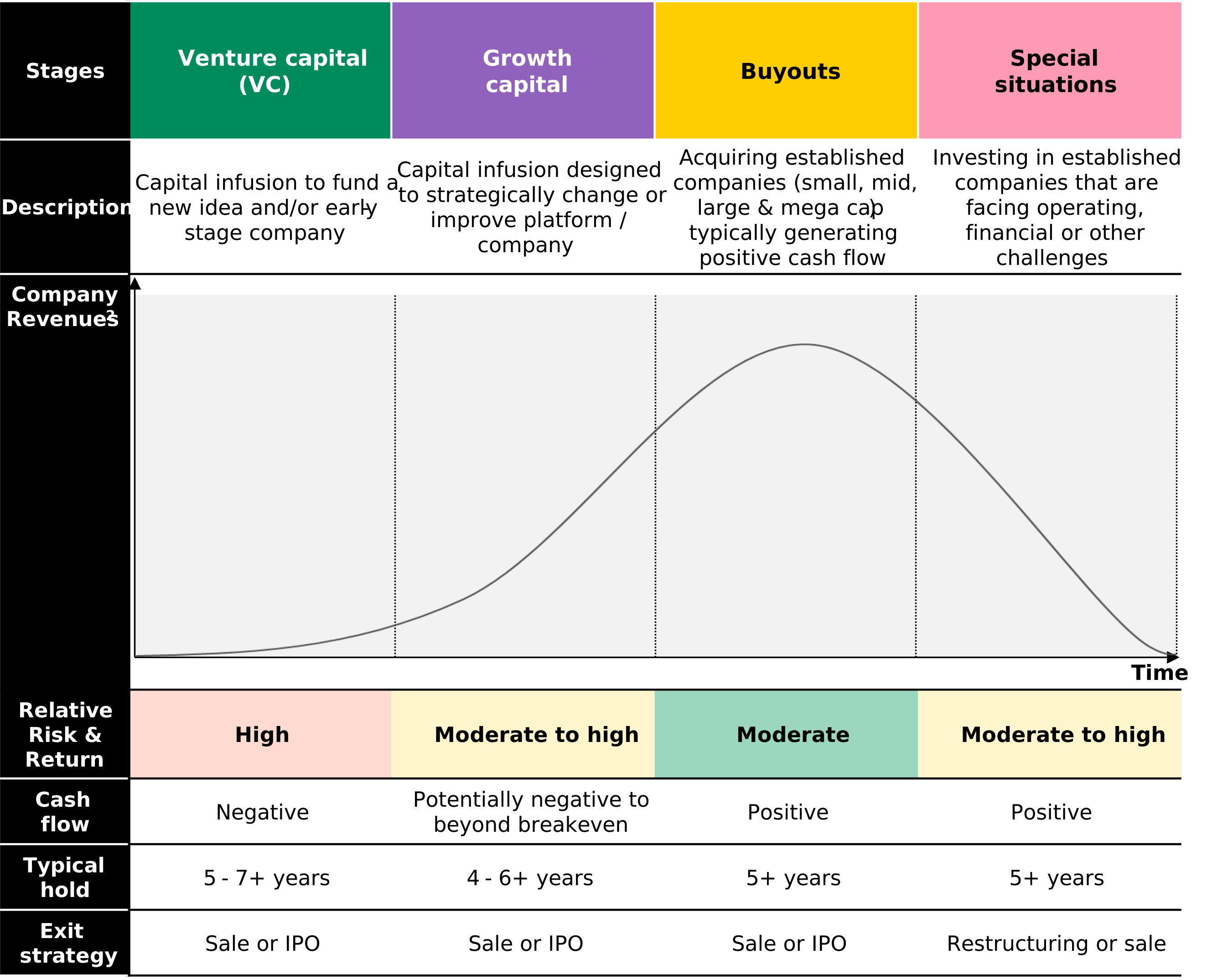
The above table is for illustration purposes only. It serves as a general summary and is not exhaustive. Characteristics such as risk, return and holding period can vary significantly by strategy and manager.
How can investors access private equity?
Investors generally access private equity in three ways:
1. Primaries
A primary investment involves committing capital to a newly raised private equity fund managed by a GP. Investors, known as Limited Partners (LPs), provide the capital. LPs can commit to a single fund, or sometimes to a fund-of-funds, which invests across multiple private equity funds to provide broader diversification, and the GP deploys capital over time as investment opportunities arise, ultimately building a diversified portfolio.
Early in a fund’s investment period, as capital is deployed and fees are paid while portfolio companies are still being improved, investor returns may be negative. The fund’s net cash flow can begins to increase in the later years when investments begin to mature and are sold, resulting in distributions. This progression from initial negative return to ultimately positive return is known as the J-curve effect.
2. Directs and co-investments
Direct investing involves investing in a privately held company, often alongside a GP. When a GP seeks to acquire a company, they may invite select partners to co-invest. In some cases, investors may also invest directly in companies independently.
Co-investments allow investors to gain exposure to a specific company as a co-owner. Because capital is deployed into a specific investment rather than committed to a blind pool of future opportunities, investors may gain exposure more quickly compared to primary fund investments and it can help mitigate the early phase of the J-curve. Co-investments can also enhance transparency and offer a two-tiered due diligence approach, first by the GP and then by the co-investor. In addition, they may involve a different fee structure and, in some cases, lower overall fees than traditional private equity fund investments.
However, co-investments require significant underwriting expertise and internal resources to evaluate potential opportunities. They also involve higher concentration risk, as investors are exposed to a single company rather than a diversified portfolio, and execution risk, as not all transactions ultimately close.
3. Secondarie
Secondaries involve purchasing existing interests in private equity funds or direct investments. In these transactions, investors acquire the fund interests of existing Limited Partners who are seeking liquidity before the fund’s scheduled term ends.
Secondary interests are often purchased at a discount to the asset’s net asset value (NAV), generally not due to impairment in the underlying investments, but because of the illiquidity of the LP stake and the seller’s need to receive capital back sooner than originally anticipated.
Secondaries provide more immediate exposure to underlying portfolio companies and can reduce the impact of the J-curve by offering access to investments that are closer to realization or exit.
Exhibit 2: Building blocks of private equity investing
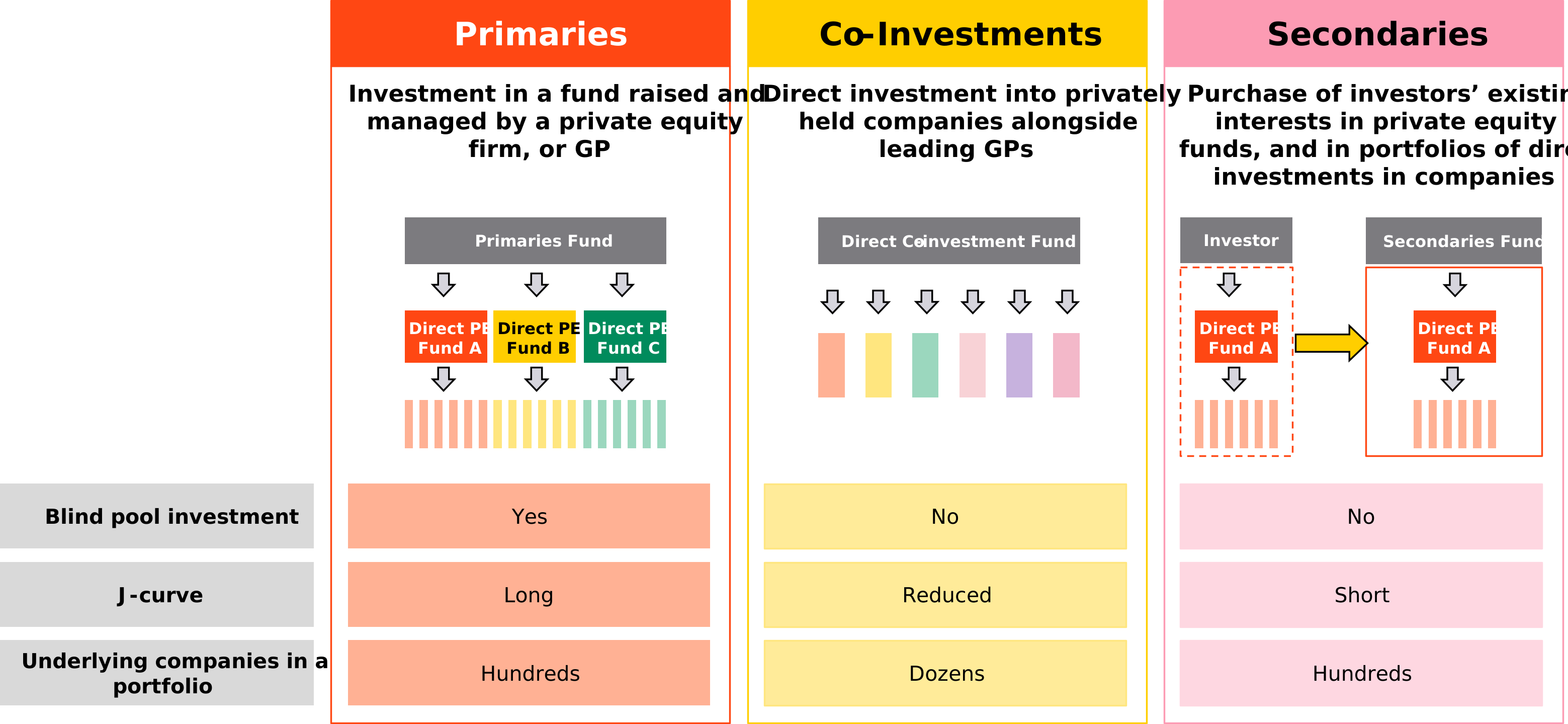
The above is for illustrative purposes only and is not exhaustive. BlackRock, as of 30th April 2026.
*A “blind pool” refers to a fund where investors commit capital before the underlying investments have been identified. The manager then selects and invests in companies over time.
**The J-curve refers to the pattern where returns can be negative in the early years of an investment before turning positive over time as investments mature and are realised.
Why invest in private equity?
- Breadth of opportunity
Private equity allows investors to access opportunities beyond those available in public equity markets. In the U.S., public markets have been shrinking as the number of public companies has declined; in contrast, the number of private companies has risen.2 In the U.S., private companies make up 80 percent of the total number of companies with revenue greater than $100 million, while public companies represent only 20 percent.3
Exhibit 3: US public markets have been shrinking, while US private markets have been growing2
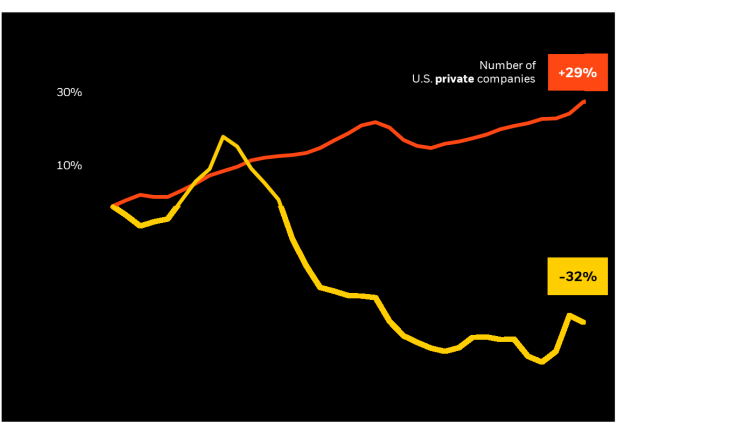
Source: 2. U.S. Census Bureau - Center for Economic Studies - Business Dynamics Statistics (2022) and World Federation of Exchanges database; for more information on the World Federation, please refer to the Important Notes. Both sources, represents the latest data as of 2022 as derived on 2 April 2025. The graph denotes the growth or decline for both US public and private companies from 1988 until 2022. Past performance is no guarantee of future performance. 3. S&P Capital IQ, BlackRock. Data as of April 22, 2026. Represents the number of global companies with annual revenues greater than $100 million.
2. Potentially attractive absolute and relative returns
Private equity investors aim to optimize returns through influencing a company’s strategy over a longer time horizon. Once a business is acquired, improvements can be made to increase value prior to exit – making manager skill a primary return driver. Moreover, private companies are often smaller and can be accessed earlier in their growth cycle, potentially improving absolute returns.
3. Lower relative volatility
Private equity has tended to exhibit lower long-term volatility compared to public equities because private company valuations are generally less influenced by short-term market sentiment. Sponsors often invest with longer holding periods and time horizons, reducing the pressure to sell during market volatility or manage to quarterly earnings reports.
What are the risks of private equity investing?
As in public equities, investors in private equity are subject to market risk and operational risk. However, private equity carries additional risks including the illiquidity of the underlying assets, limited regulatory oversight and fewer reporting requirements relative to publicly traded counterparts. Investors expect a higher return for their private equity investments in exchange for these heightened risks.